
Solving Heavy-Flow Leakage: Pads vs. Menstrual Pants
Solving Heavy-Flow Leakage with Disposable Sanitary Napkins and Menstrual Pants
Leakage complaints are the most expensive quality signal a feminine hygiene brand receives, because they arrive after the sale, they land in public reviews, and they attach to the brand rather than to the factory that made the product. In most OEM programmes that Ecolivia reviews, however, heavy-flow leakage is not caused by a defective pad. It is caused by a format that was specified for one scenario being sold into another: a daytime ultra-thin pad sold as an overnight product, a 240 mm pad placed in a postpartum care programme, or a menstrual pant sized from a waist measurement that never matched the wearer.
This guide takes a scenario-led route through that problem. It separates the leakage mechanisms that look identical in a one-star review, sets out when disposable menstrual pants should replace standard disposable sanitary napkins, and closes with a troubleshooting checklist that OEM and private-label buyers can work through before changing a specification.

What heavy-flow leakage actually is
Leakage is a symptom with three distinct mechanisms. They produce the same complaint sentence and require different corrective actions, which is why changing the absorbency number alone so often fails to reduce the complaint rate.
1. Core saturation
The absorbent core has taken on as much fluid as its construction allows, and the next flow has nowhere to go, so it exits at the ends of the pad. The signature is a product that is wet through its full length, with leakage appearing later in the wear period rather than immediately after application.
2. Lateral wicking and edge failure
Fluid spreads sideways across the surface faster than the core can draw it downward. Staining appears at the side edges while the centre of the pad is still comparatively dry. This pattern is often misreported as a capacity problem, and adding SAP to the core does not correct it.
3. Fit and containment gaps
The product is simply not where it needs to be. Wings detach, the pad twists, or the seal opens at the front or back when the wearer moves or lies down. Staining appears along the waistband line of the underwear while the pad itself is only lightly used.
Postpartum flow adds a fourth variable. Volume is higher and less predictable in the first days after delivery, and a large share of the wear period is spent lying down. A product that performs acceptably while the wearer is standing can fail when the wearer is supine, because posture changes the direction in which fluid travels relative to the core.
Why complaint volume rises as SKU counts rise
Format mis-specification is more likely today than a decade ago, for three structural reasons on the supply side.
Export scale and private-label proliferation. China's sanitary napkin exports reached 1.14 million tonnes in 2025, a 9.2% year-on-year increase, with the United States (21% of exports), Germany (12%) and the United Kingdom (9%) as the leading destinations, according to a 2026 China hygiene sourcing whitepaper. Higher export volume means more private-label programmes, and every programme adds SKUs that need to be specified separately rather than copied from a neighbour's tech pack.
Material transition without re-validation. The move from conventional polyethylene backsheets and standard SAP toward bio-based cores and breathable bio-films changes how a product manages moisture and how it feels in use. It does not automatically change absorbency, and a brand that swaps materials without re-validating performance can inherit complaints its previous specification never produced.
Sub-segment claims. Overnight, heavy flow, postpartum, sensitive skin and eco-positioned lines each imply a different performance envelope, but they are frequently served by the same base construction. One commercial estimate places the global biodegradable sanitary napkin segment at US$3.53 billion in 2025, rising to US$14.93 billion by 2034 at a 17.38% CAGR (The Insight Partners). That is a single commercial forecast rather than an official statistic, and its only practical use here is narrower: eco-positioned lines are being launched at a volume where specification discipline starts to matter commercially.
One absorbency problem, two product answers
Ecolivia is the disposable sanitary napkin brand supplied by Family Cares Group, an integrated hygiene and medical materials manufacturer headquartered in Xiamen with production based in the hygiene cluster of Quanzhou, China. The group reports 35,000+ square metres of factory space, 350–500 employees and annual output above 650 million pieces. Its portfolio answers heavy-flow leakage with two formats that are built for different failure modes rather than for different price points.
FC-Standard Series disposable sanitary napkins: the daytime and variable-flow answer
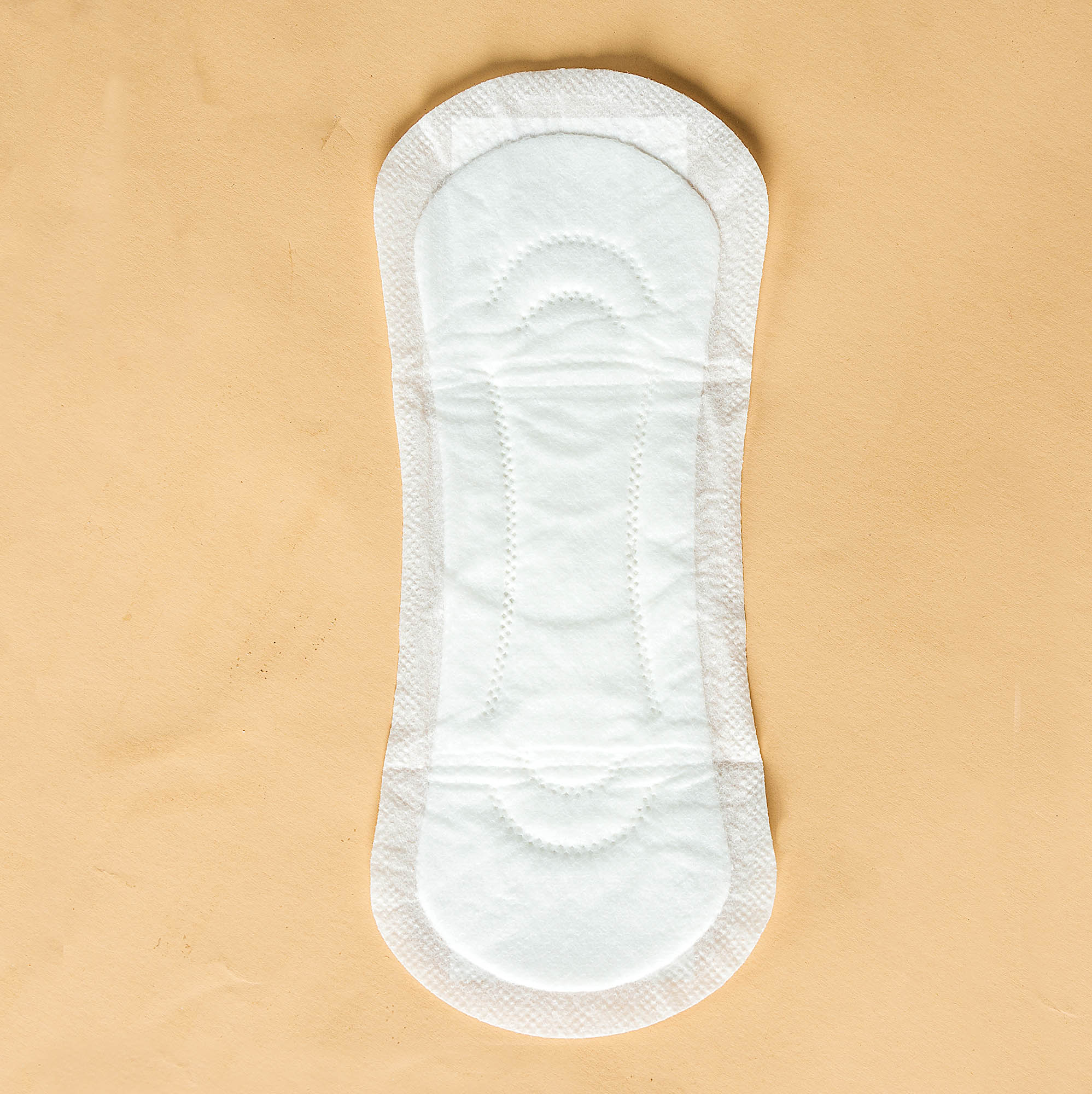
The FC-Standard Series is specified at 240 mm, 285 mm, 330 mm and 410 mm with a non-woven fabric top sheet, a super absorbent polymer (SAP) core and a breathable bio-film backsheet, and it is positioned for wholesale, B2B distribution and supermarket retail. Two elements do most of the containment work.
The SAP layer is what converts a pulp-based pad into a high-capacity product: it absorbs many times its own mass and holds the fluid as a gel inside the core rather than letting it sit loosely near the surface, which is why SAP content is the first variable to check when saturation complaints appear at the top of the length ladder. The breathable bio-film backsheet is the second element: it retains liquid while allowing vapour to pass, reducing the sealed, damp sensation that generates complaints which are not strictly leakage. Family Cares reports a 40% increase in airflow for plant-based bio-film backsheets compared with standard PE backsheets; that is a supplier-reported comparison and should be read as such rather than as an independent laboratory result.
Length is the third control. In practice, brands use the 240–410 mm ladder to cover flow variation across the cycle without changing the construction underneath, which keeps tooling and qualification work to one platform. Where a programme needs a wider material story, the Ecolivia-Bio Series runs from 155 mm to 450 mm in organic cotton, bamboo fibre or an advanced bio-based core, with absorbency customisable across high, super and night grades.
FC-Pants Series menstrual pants: the overnight and postpartum answer
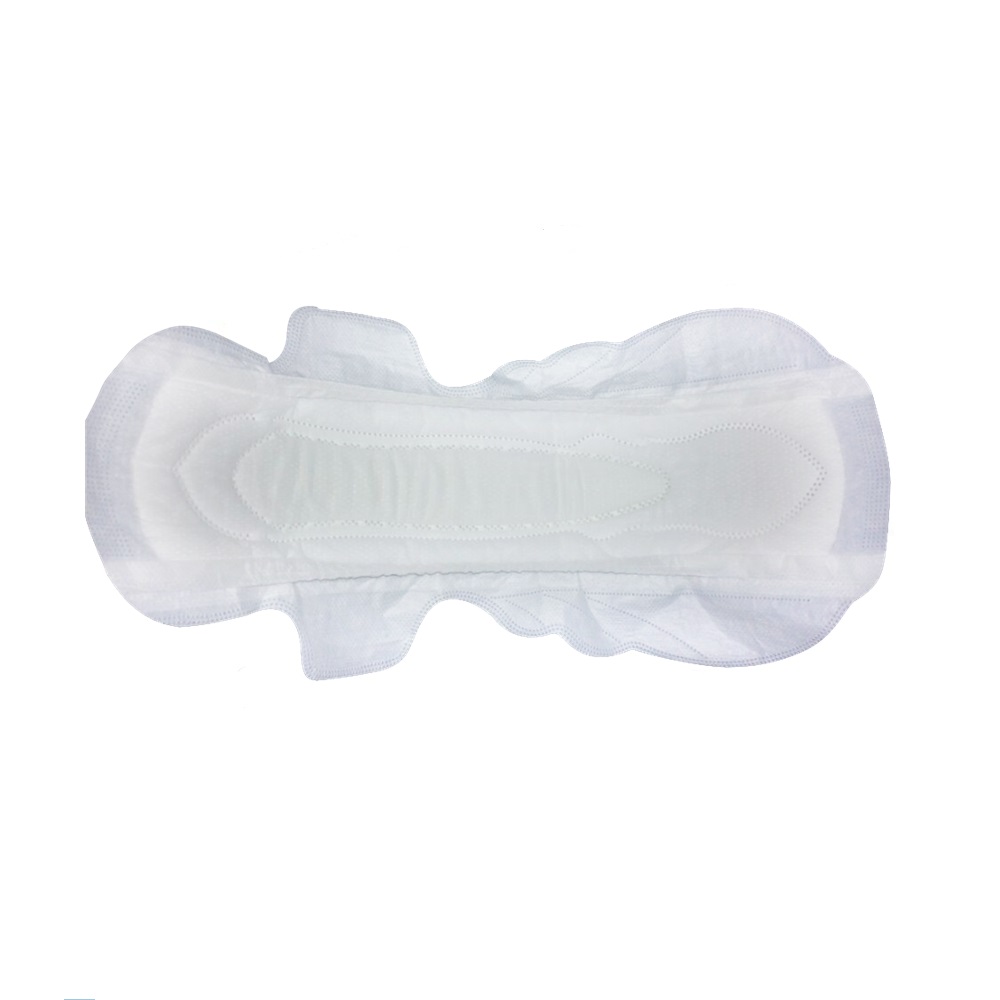
FC-Pants Series is a 360° leak-proof underwear format supplied in M-L and L-XL, covering a waist range of 60–120 cm, with a stated absorbency of 150–300 ml that can be customised. The construction uses an ultra-soft non-woven surface, an advanced bio-based absorbent core and an elastic waistband, and the format is positioned for retail, FMCG and postpartum care.
The difference from a pad is not only capacity; it is anchoring. A pad is held in place by adhesive and wing folds, so its position depends on the underwear and on the wearer's movement. A menstrual pant suspends the absorbent panel from an elastic waistband, which holds the core against the body through changes in posture. That is precisely the mechanism that resolves the front-and-back staining pattern a pad cannot fix by becoming thicker, and the 360° coverage removes the side-seam exposure responsible for edge staining when a pad shifts.
One boundary is worth stating plainly, because it causes avoidable complaints in both directions. Menstrual pants are not an incontinence product. Family Cares' adult brief line, FC-Care Pro, is specified at 1,500–8,000 ml+ absorbency with a bio-based absorbent core and 3D leak guard construction for healthcare, senior care and medical supply. Placing menstrual pants in an institutional incontinence programme, or an adult brief in a postpartum retail programme, is a category error that will surface as a complaint regardless of product quality.

A five-step diagnostic for a leakage complaint
The sequence below is deliberately ordered so that format is settled before construction is touched. Reversing it is the most common reason a specification change fails to reduce a complaint rate.
- Classify the complaint by location and timing. Record where the staining appears (side edge, front, back, full pad), when it appears (immediately after application, mid-wear, only overnight, only on the heaviest days), and who reports it (a single wearer, a cluster within one SKU, or several markets). This single step usually eliminates two of the three possible mechanisms.
- Reconstruct the scenario before the product. Capture sleep position, wear duration, flow day, postpartum status, underwear type and activity level. A tech pack that does not state the scenario cannot be validated against it, and a wear test run without a scenario definition produces results that cannot be reproduced.
- Test the format hypothesis before the build hypothesis. Where the complaint is lightly used product with stained underwear, overnight wear, supine rest or the first postpartum days, move the scenario to menstrual pants first. Where the complaint is a saturated pad on a variable-flow day, work the length ladder and SAP content inside the pad platform.
- Audit the construction only after the format is settled. Check SAP content and core integrity, backsheet specification, wing adhesive coat weight, cutting tolerance and non-woven GSM. Family Cares runs 100% on-line visual inspection plus in-house laboratory QC on OEM/ODM production, and material supply is supported by batch COA reports, which is what makes a construction-level comparison possible at all.
- Define acceptance criteria and re-test against them. Write the pass/fail definition before sampling, not after, and state the scenario each sample is meant to serve. Without that, a re-test simply produces a second opinion.
Scenario fit: which programmes should carry which format
Most leakage-driven range decisions resolve into a small number of programme types.
- Overnight heavy-flow retail. Menstrual pants, sized across both M-L and L-XL so the 60–120 cm waist range is genuinely covered rather than nominally listed.
- Postpartum care retail and discharge programmes. Menstrual pants for the first days, with 330–410 mm pads carried alongside for later, lighter flow so the programme does not force one format onto the whole recovery period.
- Daytime retail and value packs. FC-Standard Series 240–330 mm, where discretion and unit economics matter more than maximum capacity.
- Subscription and boutique retail. Box-packed premium formats, where the decision is a channel and packaging decision rather than a leakage decision, and should not be allowed to displace the leakage specification.
- Distributor bulk orders. Mixed pallets that carry both formats, because a distributor's complaint rate is driven by whichever scenario its retailers cannot serve.
A leading regional FMCG brand in Malaysia has run organic cotton sanitary napkins and menstrual pants with Family Cares for more than three years at 2–3 x 40HQ containers per month. The case record notes that the programme integrated the advanced bio-based core to replace standard SAP, and lists 25% annual sales growth in Southeast Asia as the recorded result. The transferable point is not the growth figure; it is that both formats were carried inside one programme, which is what allowed the brand to answer overnight and postpartum complaints without qualifying a second supplier.

Format comparison on documented specifications
The table compares only specifications stated for each series. It is not a performance ranking, and it does not establish that one format outperforms the other in the same scenario, because the two are built for different scenarios.
| Dimension | FC-Standard Series (disposable sanitary napkins) | FC-Pants Series (menstrual pants) |
|---|---|---|
| Format | Mass-market pads for wholesale, B2B distribution and supermarkets | 360° leak-proof underwear for retail, FMCG and postpartum care |
| Stated sizes | 240 mm, 285 mm, 330 mm, 410 mm | M-L and L-XL, waist 60–120 cm |
| Stated absorbency | High-speed absorption core (no single ml figure published for the series) | 150 ml – 300 ml, customisable |
| Construction | Non-woven fabric / SAP / breathable bio-film | Ultra-soft non-woven / advanced bio-based absorbent core / elastic waistband |
| Containment mechanism | SAP locks fluid in the core; backsheet retains liquid while allowing vapour through; length ladder covers flow variation | Elastic waistband anchors the core to the body; 360° coverage removes side-seam exposure |
| Best-matched scenario | Daytime and variable flow; value packs; distributor bulk | Overnight heavy flow; postpartum first days; travel and long wear periods |
| Weakest fit | Supine overnight wear and postpartum gush, where fit rather than capacity is the failure | Low-flow daytime use, where unit cost exceeds the benefit |
OEM buyer troubleshooting checklist
Work through the checklist in order. Each row maps a reported symptom to the check that identifies the cause, and to the action that is proportionate to it.
| Symptom reported | First check | Most likely cause | Proportionate action |
|---|---|---|---|
| Staining at the front or back waistband while the pad is only lightly used | Wearer posture and wear duration in the reported scenario | Fit and containment gap, not capacity | Move the scenario to menstrual pants, or specify the longest pad in the ladder with a wider rear; confirm in a scenario-defined wear test |
| Side-edge staining early in the wear period | Pad width, wing adhesive and the underwear actually used in that market | Lateral wicking combined with product movement | Review cut width and adhesive coat weight; test with the underwear type used in the destination market |
| Full-length saturation before the expected change interval | SAP content and core integrity | Capacity shortfall against the market's flow profile | Raise SAP loading or step up one length; re-test against written acceptance criteria |
| Pad twisting or wings detaching | Adhesive specification and wing geometry | Containment failure caused by adhesive, not by absorbency | Adjust adhesive and wing design with the material team before touching the core |
| Waistband marks, roll-down, or a leg gap in pants | Which size band the market actually needs within 60–120 cm | Wrong size mix rather than a wrong product | Sample both M-L and L-XL across the target population before re-specifying the product |
| Wetness or odour complaint with no visible leakage | Backsheet specification | Moisture retained under a low-permeability backsheet | Review the breathable bio-film option rather than adding absorbency |
| Complaint cluster in one market only | Storage conditions, shelf life and distribution chain | Damage or ageing in transit, not a product defect | Investigate logistics before changing a specification that performs elsewhere |
Frequently asked questions
Do we need documentation before printing an absorbency or leak-proof claim on-pack?
Yes. Claims such as a 150–300 ml absorbency range or 360° leak protection should be tied to a defined test method and a supplier report covering the specific SKU, because a regulatory listing does not test performance. The U.S. FDA establishment registration and device listing database does contain sanitary napkin and panty liner records, but those records establish listing status, not absorbency. Family Cares states that its operations are ISO 9001 certified and that products are aligned with FDA, CE and GOTS requirements; request the certificate scope and the SKU-level test report, then confirm both against your destination market's own requirements before artwork is released.
Can the FC-Pants absorbency be set within the stated range for our market?
FC-Pants Series is stated at 150 ml to 300 ml and the figure is customisable, so a programme can be specified toward the lower end for moderate overnight use or the upper end for heavier flow and postpartum positioning. Because the range is a specification band rather than a single fixed value, confirm the target figure in writing on the tech pack and verify it on the sample before the production order.
What waist sizes can we plan a menstrual pant range around?
FC-Pants Series is supplied in M-L and L-XL and covers a 60–120 cm waist range across those two sizes. The practical planning question is not the outer limit but the size mix: a two-size range has to match the body-size distribution of the destination market, so sample both sizes on the target population rather than assuming an even split.
What drives the unit cost gap between pads and menstrual pants?
For standard ultra-thin pads in China, a 2026 industry sourcing whitepaper reports an FOB band of US$0.018 to US$0.032 per unit, depending on SAP content and top sheet material. Menstrual pants consume more material and add an elastic waistband, and the same source does not publish a comparable price band for that format, so the honest step is to request a quoted price against a written bill of materials rather than extrapolating from the pad range.
How should we structure a sample trial before committing to an order?
Define the complaint scenario first, then request samples in both formats and in adjacent sizes within the same format, so the trial tests the format hypothesis rather than a single SKU. Family Cares provides sample testing support through its material supply operation, and OEM/ODM production runs 100% on-line visual inspection plus in-house laboratory QC with batch COA reports on materials, which gives you documents to compare against your own acceptance criteria. Record pass/fail per scenario, not per product.
What are the lead times and the minimum order quantity?
OEM/ODM manufacturing runs 15–25 days with a minimum order of 1 x 20GP, which is negotiable for start-up brands; material supply runs 7–14 days at a minimum of 2 tonnes or 1 x 40GP depending on the material; and logistics treatment is 3–5 days, with 30+ 40HQ containers handled per month on FOB, CIF or DDP terms. Buyers who want to test FC-Pants and FC-Standard side by side can request a sample set or a specification-matched quote through Family Cares Group before locking the range.
Conclusion
Heavy-flow leakage is a specification problem more often than a manufacturing problem, and the three mechanisms behave differently. Saturation responds to SAP content and the length ladder inside the disposable sanitary napkin platform. Lateral wicking responds to width, surface and adhesive. Fit and containment respond to format, because an elastic waistband anchors the absorbent panel in a way that adhesive never can.
The practical consequence for brand owners and OEM buyers is that pads and menstrual pants should not be placed in competition. FC-Standard Series covers daytime and variable flow at a distributor-friendly cost. FC-Pants Series covers overnight, supine and postpartum scenarios where the failure is positional rather than volumetric. Qualifying both on one supply platform, and writing the scenario into the tech pack before the artwork, is what stops a leakage complaint from becoming a repeat complaint.
Have Questions or Need More Details?
Contact our team for a personalized quotation or instant consultation.
Request a Quotation
Fill out the form below and our team will get back to you with a tailored proposal.
WhatsApp Direct Chat
Prefer to chat in real-time? Message us on WhatsApp for instant assistance & quick answers.
- Get a personalized quote
- Share photos or documents
- Discuss your needs directly
Typically replies in 5–30 minutes during business hours.