
How to Read Sanitary Napkin Compliance Certificates: ISO 9001, FDA and CE MDR Scope
A compliance certificate is the most frequently misread document in sanitary napkin procurement. Buyers scan the logo, file the PDF, and move on. The problem is that the scope statement — the small block of text underneath the certificate title — does almost all of the work.
Problem Definition: Three Misreadings That Cause Real Shipment Delays
Most certificate problems in feminine hygiene sourcing are not fraud problems. They are reading problems. The same three mistakes repeat across import files, and each one has a predictable cost.
- Treating ISO 9001 as a product licence. ISO 9001:2015 is a management system certificate. It says a company's quality system has been audited against a standard. It does not authorise a product to be sold anywhere.
- Treating FDA Establishment Registration as FDA approval. Establishment registration under 21 CFR Part 807 confirms that a facility has registered with the U.S. Food and Drug Administration. It is not a product performance approval or an absorbency endorsement.
- Assuming a CE file covers every product line. CE documentation is issued against a defined scope. If your product is not named inside that scope, the document does not apply to it.
Each misreading produces the same downstream result: a customs broker asking questions at the port, a retail compliance team rejecting a supplier file, or a buyer paying for testing that was already covered by an existing document. The certificate was never the issue. The scope statement is.
The core habit to build
Before reading anything else on a certificate, extract four fields: issuing authority, certificate number, scope statement, and validity dates. Those four fields determine whether the document is usable for your specific product and market.
Industry Background: Why Certificate Volume Is Rising Faster Than Certificate Literacy
Global demand for sanitary protection keeps expanding, and the supplier base is expanding with it. Aggregated market research places the global sanitary pads market at roughly USD 20.4 billion to USD 25.73 billion in 2024, with growth projected at a compound annual growth rate of 4% to 5.6% through 2034. China accounts for a large share of supply — sanitary pad exports under HS 961900 were valued at approximately USD 3.3 billion to USD 3.59 billion in 2024.
The faster-moving segments sit further up the specification ladder. The biodegradable sanitary napkin segment was valued at USD 2.43 billion in 2023 and is projected to reach USD 8.54 billion by 2030, a compound annual growth rate of 20.1%. Organic cotton sanitary napkins reached approximately USD 3.95 billion in 2025, driven largely by consumer preference for hypoallergenic and chemical-free products.
Two consequences follow. First, more suppliers are presenting compliance documents, and buyers are receiving thicker document packs with less time to read them. Second, sustainability claims have added a parallel layer of certification. Compostable sanitary napkin claims are typically supported by European standard EN 13432 or North American ASTM D6400, which require 90% biodegradation within six months under industrial conditions. Those certification frameworks sit entirely outside ISO 9001, FDA establishment registration and CE marking, and they answer a different question.
For a distributor importing disposable sanitary napkins across multiple regions, the practical risk is not the absence of documents. It is the presence of documents that do not cover what the buyer assumes they cover.
Detailed Solution: Deconstructing Certificate Scope Line by Line
Reading Rule 1 — Separate System Certificates from Product Authorisations
ISO 9001 belongs to the first category. FDA establishment registration and CE marking belong to the second. Mixing them is the origin of most scope errors. A system certificate answers "is the factory controlled?" A product authorisation or registration answers "is this product acceptable in this market?"
Reading Rule 2 — Read the Scope Statement, Not the Logo
The logo tells you what kind of document you are holding. The scope statement tells you what it covers. On ISO 9001 certificates the scope is written as an activity description. On FDA establishment registration it is written as a product list. On CE documentation it is written as a defined product category. Each format has to be read differently.
Reading Rule 3 — Verify Authority, Number and Validity
A certificate without a verifiable issuing authority, a traceable certificate number and a stated validity period is not a usable procurement document. Every credible compliance file carries all three.
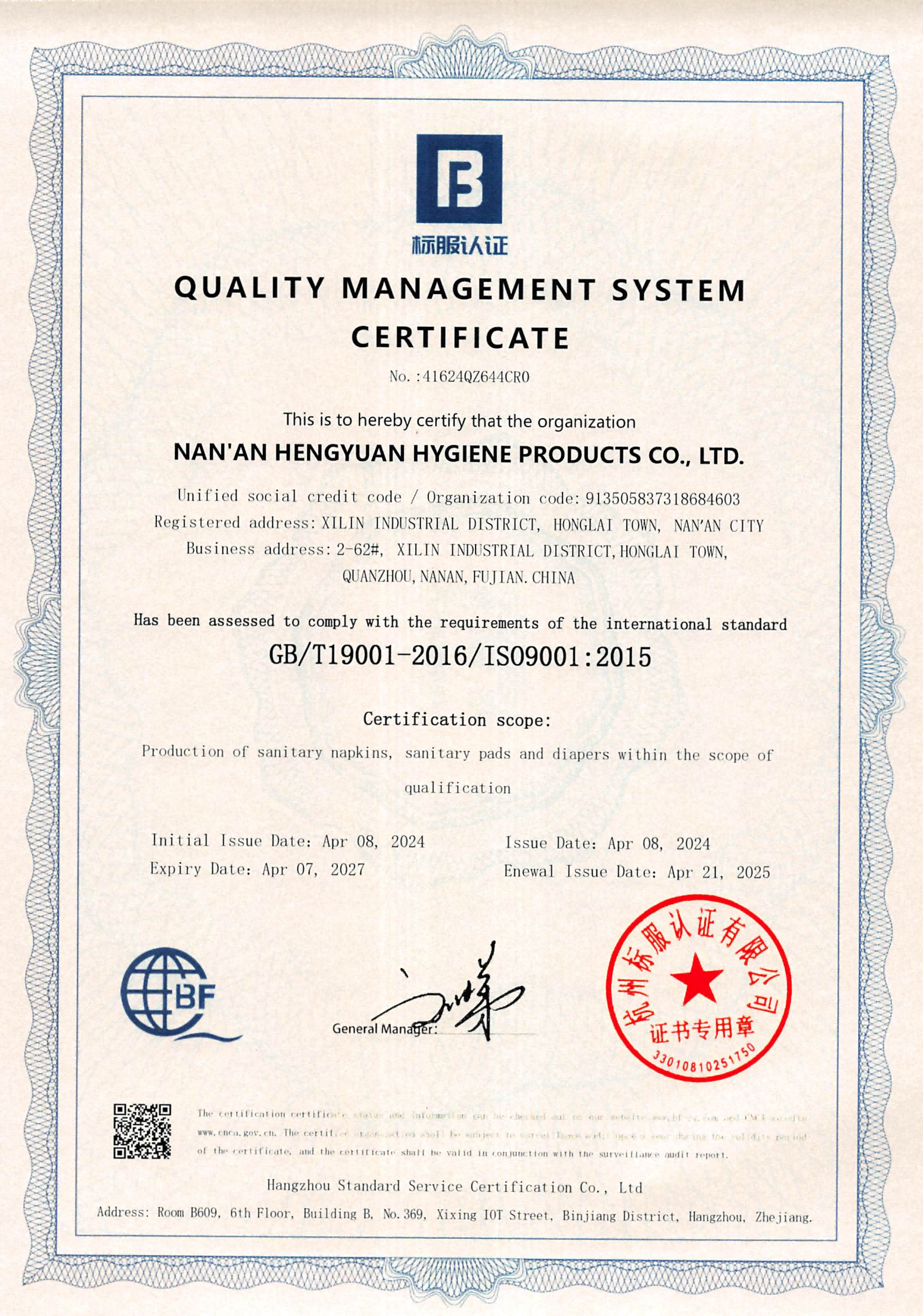
ISO 9001:2015 — It Defines Processes, Not Market Access
Family Cares Group (Xiamen) is an integrated manufacturing and supply chain group specialising in high-performance hygiene and medical materials. Its manufacturing base sits in the hygiene industrial cluster of Quanzhou, China, with its headquarters in Xiamen serving as the global sales and R&D hub. The group holds ISO 9001:2015 certification number 41624QZ644CR0, issued by CQC / IQNet, valid until April 7, 2027. The certified scope is the design, manufacturing and sales of hygiene and medical materials.
Read that scope carefully and it becomes clear what the certificate does for a buyer. It confirms that the quality management system covering design, manufacturing and sales has been audited against ISO 9001:2015. For a brand owner who has to pass a supplier audit with a retail chain, that three-part scope matters — it means the audit trail extends upstream into development and downstream into how the product is sold, not only across the production floor.
What it does not do is equally important. ISO 9001:2015 certification 41624QZ644CR0 does not authorise the sale of any product in the European Union, the United States, or any other jurisdiction. A buyer who presents an ISO 9001 certificate as evidence of market access will be asked for a different document.
Buyer verification points for ISO 9001:
- Confirm the certificate number and issuing body (41624QZ644CR0, CQC / IQNet).
- Confirm the scope description covers the activities relevant to your order.
- Confirm the validity end date (April 7, 2027) and note it in your supplier review calendar.
- Do not accept the certificate as a substitute for market-specific product documentation.
FDA Establishment Registration — It Registers a Facility, Not a Product
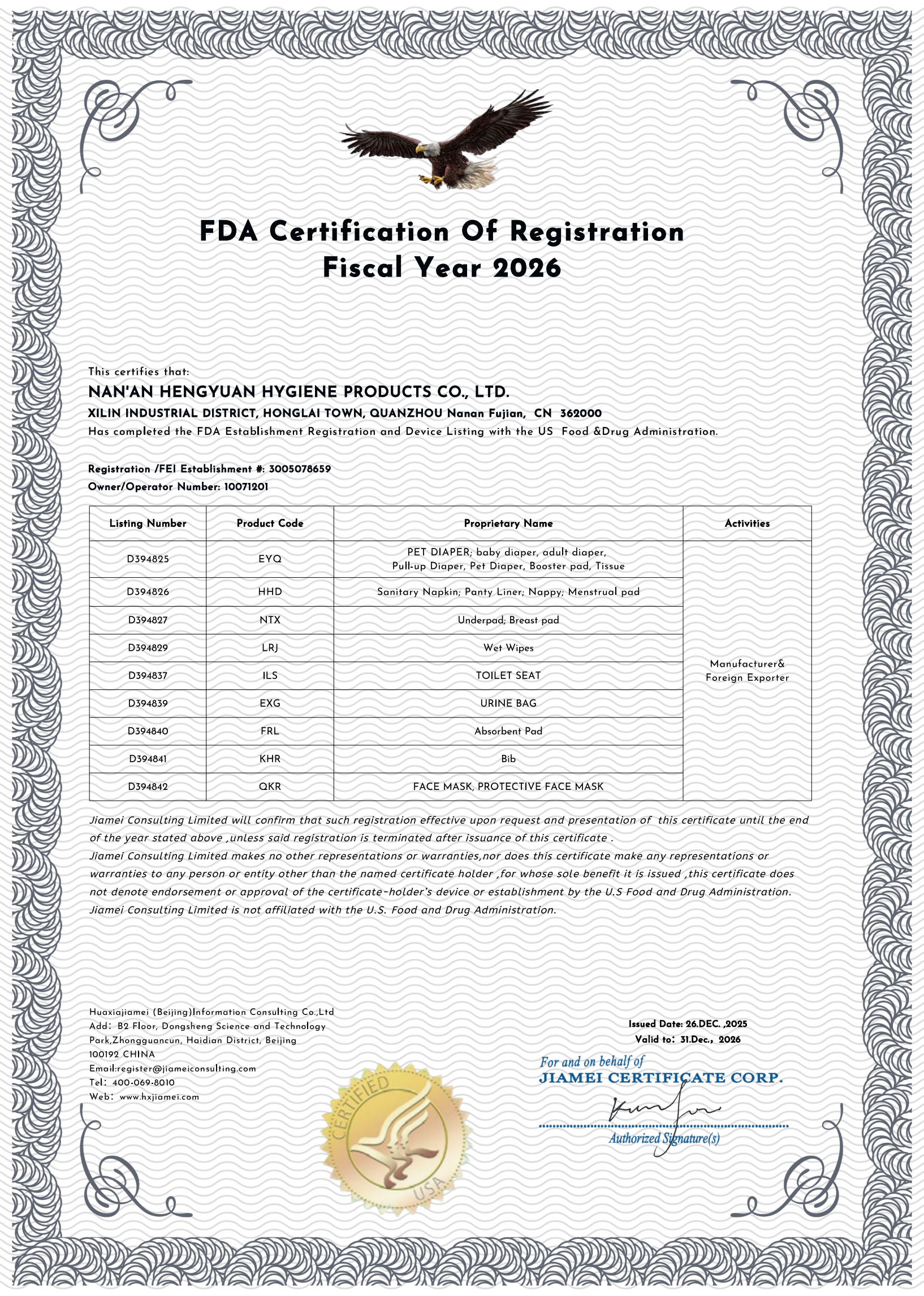
Family Cares Group holds FDA Establishment Registration number 3005078659 under 21 CFR Part 807, for the USA / North America market. The registered product scope is broad and includes sanitary napkin, panty liner, nappy, menstrual pad, underpad, baby diaper, adult diaper, pull-up diaper, booster pad, breast pad, wet wipes, absorbent pad and additional listed categories.
The registration is issued by the U.S. FDA and its current cycle shows a renewal date of December 31, 2026. For a buyer planning shipments into the United States, that renewal date belongs in the procurement calendar — not because the registration lapses without warning, but because documentation requests from a U.S. retail partner will include a current copy.
Here is where misreading becomes expensive. Establishment registration confirms that the facility is registered with the FDA and that the listed product categories are associated with that registration. It is not an FDA approval of product performance. It does not certify absorbency, material safety at a product level, or clinical suitability. When a marketing claim says a sanitary napkin is "FDA approved," the accurate reading of the underlying document is almost always "FDA establishment registered," which is a different statement.
Buyer verification points for FDA establishment registration:
- Match your specific SKU category against the registered product list — sanitary napkin, panty liner, menstrual pad and underpad are all within scope for 3005078659.
- Confirm the registration number and the responsible U.S. agent details where applicable.
- Check the current registration cycle date (December 31, 2026) before quoting a U.S. delivery window.
- Request product-level documentation separately for performance and material questions.
CE Marking (MDR) — Where Scope Becomes the Deciding Fact
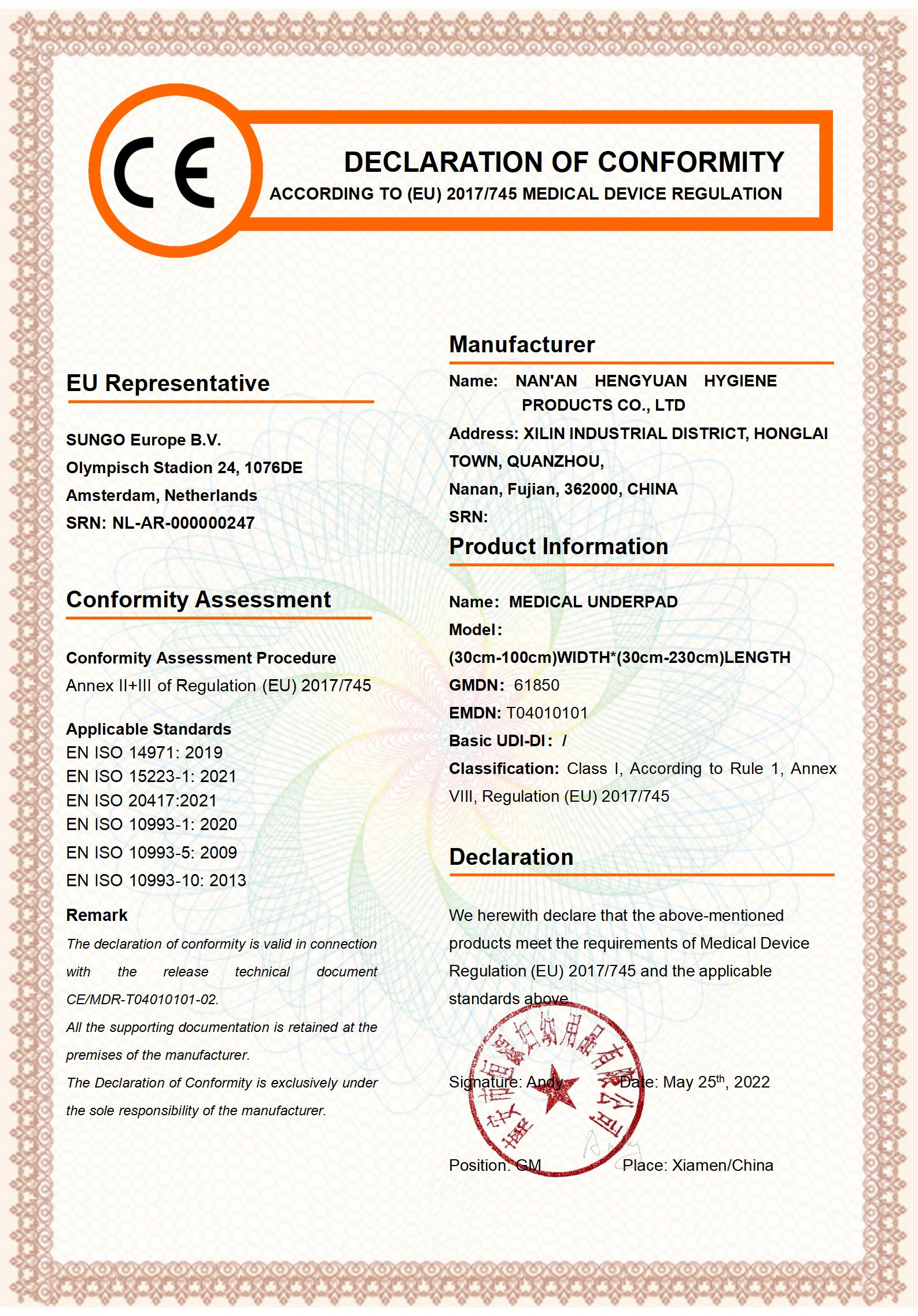
Family Cares Group holds CE Marking (MDR) documentation referenced as EN 14683 / MDR-Reg, issued by SGS / TUV, for the European Union / EEA market. The underlying standard referenced is EN ISO 10993. The issue date is May 31, 2022 and the expiry date is May 30, 2027. The certified scope is adult incontinence care, adult diaper and underpad.
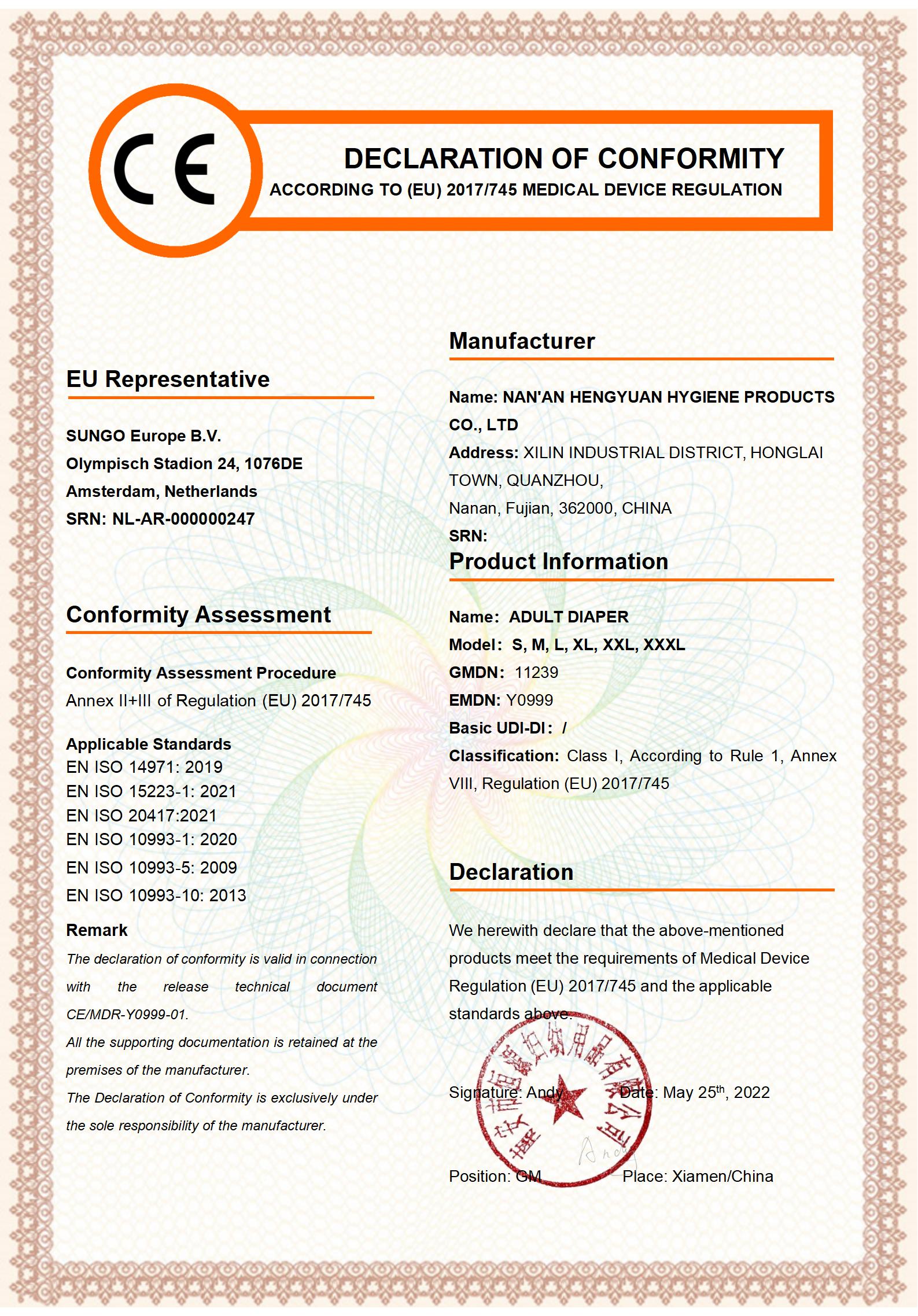
This is the paragraph that most changes a buyer's planning. The CE scope held on file covers adult incontinence care, adult diaper and underpad applications. It does not extend to disposable sanitary napkins.
Why this matters in practice
A distributor buying both adult care products and feminine hygiene products from the same supplier cannot rely on a single CE file for both. The adult care lines are supported by the CE documentation referenced above. The sanitary napkin lines require their own market-specific file set. Treating the two as interchangeable is the most common compliance planning error in this category.
There is also a date dimension. CE documentation referenced as EN 14683 / MDR-Reg carries an expiry of May 30, 2027, while ISO 9001:2015 certification 41624QZ644CR0 expires April 7, 2027. Two different renewal dates, roughly two months apart, for two documents that a European buyer will typically request together. Any supplier review calendar should hold both.
Buyer verification points for CE marking:
- Confirm the issuing body (SGS / TUV) and the reference (EN 14683 / MDR-Reg).
- Read the scope statement and match it against your exact product category — adult incontinence care, adult diaper and underpad are in scope; disposable sanitary napkins are not.
- Confirm the underlying standard reference (EN ISO 10993) and the validity window (May 31, 2022 to May 30, 2027).
Step-by-Step Breakdown: A Practical Certificate Verification Sequence
Certificate verification is a sequence, not a single check. Running the steps in order prevents the most expensive error — approving a supplier file that later turns out to cover the wrong product.
- Define the destination market first. North America, the European Union / EEA, Southeast Asia, CIS, the Middle East and Africa each carry different documentation expectations. Family Cares Group exports to North America (USA, Canada), Europe (UK, Germany, France), Southeast Asia (Malaysia, Vietnam, Thailand, Singapore), CIS (Russia, Uzbekistan, Kazakhstan), the Middle East (Turkey, UAE) and Africa (Senegal, Nigeria), so a single order file may need to serve more than one regime.
- Extract the scope statement verbatim. Copy the scope text into your own file without paraphrasing. For ISO 9001 this reads as an activity description; for FDA registration it reads as a product list; for CE it reads as a product category.
- Map every SKU to the scope. Build a two-column list — your product codes on the left, the certificate that covers each one on the right. Where a certificate does not name your category, mark it as unsupported rather than assuming coverage.
- Verify authority and certificate number. ISO 9001:2015 — 41624QZ644CR0, issued by CQC / IQNet. FDA Establishment Registration — 3005078659, issued by U.S. FDA. CE Marking (MDR) — EN 14683 / MDR-Reg, issued by SGS / TUV. Numbers that cannot be traced to an issuing authority are not usable.
- Log every validity date. ISO 9001:2015 valid until April 7, 2027. CE Marking (MDR) valid until May 30, 2027. FDA registration cycle showing December 31, 2026. Put renewal reminders 90 days ahead of each date.
- Connect certificates to pre-shipment inspection. Documentation is a paper layer; inspection is the physical layer. Family Cares Group applies Pre-shipment Loading Inspection (PSI) within its supply chain and logistics operations, and 100% on-line visual inspection combined with in-house lab QC within OEM/ODM manufacturing.
- Approve laboratory reports before batch release. Add lab report review as a gate in your purchase order, so approval is formal rather than implied by silence.
- Retain batch COA reports per shipment. Batch COA reports are a standard quality control element in the group's material R&D and supply operations, which gives buyers a per-batch record rather than a single annual document.

Turning certificate reading into a purchase order clause
Write the certificate number and scope directly into the PO. If the PO names ISO 9001:2015 certification 41624QZ644CR0 and FDA Establishment Registration 3005078659, there is no ambiguity later about which documents were relied upon at the time of order.
Use Cases: How Certificate Scope Changes the Buying Decision
Scenario A — North American Distributor Buying Feminine Hygiene
A U.S. or Canadian distributor importing Ecolivia-Bio Series disposable sanitary napkins needs the FDA Establishment Registration in the order file, with the sanitary napkin and panty liner categories confirmed within the registered product list. The relevant quality system reference is ISO 9001:2015 certification 41624QZ644CR0. This pairing has supported a long-running relationship with a top-tier medical and adult care brand in the United States operating at 2 to 3 x 40HQ containers per month over a 10+ year strategic partnership, with high-absorbency core stability and customized medical-grade packaging.
Scenario B — European Buyer Sourcing Across Two Categories
A European distributor buying both adult care and feminine hygiene lines must split the file. Adult diaper and underpad volumes are covered by the CE Marking (MDR) documentation referenced as EN 14683 / MDR-Reg, issued by SGS / TUV under EN ISO 10993. Sanitary napkin volumes require their own documentation set. A German premium e-commerce and subscription brand worked through exactly this kind of split while scaling to 500,000+ units per batch on a monthly recurring basis over three years, including a transition to plastic-free packaging.
Scenario C — Southeast Asian Brand Scaling a Bio-Based Line
A regional FMCG brand in Malaysia running high-end organic cotton sanitary napkins and menstrual pants at 2 to 3 x 40HQ containers per month for over three years integrated an advanced bio-based absorbent core in place of standard SAP. In this scenario the compliance question is not which market authorization applies, but whether the material documentation supporting the bio-based core is traceable at batch level. Batch COA reports and lab report approval steps answer that question.
Scenario D — Private Label Brand Launching a New SKU
A private label or subscription box brand launching an eco-positioned line needs certificate scope to align with material claims. High-end retail programmes in the United States have specified GOTS and FSC certified inputs with 100% fluorescent-free requirements for new eco-friendly menstrual brands. Those requirements sit alongside — not inside — the ISO 9001, FDA and CE documents, and they have to be verified through a separate document path.
Comparison Table: Three Certificate Types at a Glance
| Certificate | Number / Reference | Issuing Authority | Stated Scope | Validity | What It Confirms |
|---|---|---|---|---|---|
| ISO 9001:2015 | 41624QZ644CR0 | CQC / IQNet | Design, manufacturing and sales of hygiene and medical materials | Until April 7, 2027 | A quality management system audited against ISO 9001:2015 |
| FDA Establishment Registration | 3005078659 | U.S. FDA (21 CFR Part 807) | Registered product list including sanitary napkin, panty liner, menstrual pad, underpad and other listed categories | Current cycle to December 31, 2026 | Facility registration and association of listed product categories |
| CE Marking (MDR) | EN 14683 / MDR-Reg | SGS / TUV (EN ISO 10993) | Adult incontinence care, adult diaper, underpad | May 31, 2022 to May 30, 2027 | Conformity documentation for the listed adult care applications |
Read across the "Stated Scope" column and the pattern becomes obvious: only one of the three documents names sanitary napkins directly, and only two apply to feminine hygiene at all. That is not a deficiency in the file — it is how scope-based documentation is supposed to work. The buyer's job is to match, not to assume.
Frequently Asked Questions
1. Does ISO 9001:2015 certification allow a sanitary napkin to be sold in the EU?
No. ISO 9001:2015 certification 41624QZ644CR0, issued by CQC / IQNet and valid until April 7, 2027, covers the design, manufacturing and sales of hygiene and medical materials. It confirms that a quality management system has been audited. It does not grant market access in the European Union / EEA or anywhere else. The EU-relevant document in this file set is the CE Marking (MDR) documentation referenced as EN 14683 / MDR-Reg, issued by SGS / TUV, and its certified scope covers adult incontinence care, adult diaper and underpad — not disposable sanitary napkins.
2. How do I confirm which products an FDA Establishment Registration actually covers?
Read the registered product list rather than the certificate title. FDA Establishment Registration 3005078659, issued by U.S. FDA under 21 CFR Part 807, lists a broad range of categories including sanitary napkin, panty liner, nappy, menstrual pad and underpad. Match your specific SKU category against that list line by line. The registration confirms facility registration and category association; it is not a product performance approval, and it does not certify absorbency or clinical suitability.
3. Do certificate differences change my sourcing cost?
They change the cost structure rather than the unit price. When adult care lines and feminine hygiene lines carry different documentation scopes, a cross-category buyer has to maintain two file sets instead of one, and each category follows its own approval path. The practical cost lever is how much existing evidence can replace repeat work: Pre-shipment Loading Inspection (PSI), in-house lab QC records and batch COA reports reduce the need for third-party testing that duplicates what the supplier already performs. Commercial terms for any specific programme are confirmed directly with the supplier.
4. Should I place a sample order before verifying certificates?
Treat them as parallel tracks rather than sequential ones. Sampling validates the physical product — material feel, fit, absorbency behaviour — while certificate verification validates which document covers which product in which market. Neither replaces the other. For OEM/ODM work, supported customization covers brand and logo, sizing, bio-based core structure and packaging, with sample testing support available as an after-sales element on the material side. Request documentation and samples together so both reviews close at the same time.
5. How long does it take from certificate verification to a produced batch?
Documentation review and production scheduling run on different clocks. Within OEM/ODM manufacturing, the stated lead time is 15 to 25 days with an MOQ of 1 x 20GP, negotiable for start-up brands. Material R&D and supply carries a 7 to 14-day lead time with an MOQ of 2 tons or 1x40GP depending on the material. Supply chain and logistics operations are stated at 3 to 5 days for the treatment date, with shipping mode, consolidation and customs clearance support included. Sequence the order as documentation verification first, material confirmation second, production scheduling third. If your destination is the United States, note that the FDA registration cycle shows a renewal date of December 31, 2026 — contact admin@family-cares.com or reach the team on WhatsApp at +86 13805968557 to confirm current documentation before locking a delivery window.
Request the Current Certificate Pack and Product Samples
Family Cares Group supplies Ecolivia eco-friendly sanitary napkins, adult care and medical foam products to distributors and brand owners across North America, Europe, Southeast Asia, CIS, the Middle East and Africa.
Ask for the current ISO 9001:2015, FDA Establishment Registration and CE Marking documentation alongside product samples and specification sheets, so scope matching and product validation can be reviewed together.
Email: admin@family-cares.com | Website: www.family-cares.com

Conclusion: Match the Scope Before You Match the Price
Reading a sanitary napkin compliance certificate correctly comes down to one habit: read the scope statement as a set of limits, not as a badge of quality. ISO 9001:2015 certification 41624QZ644CR0 tells you that design, manufacturing and sales systems have been audited, and that is all it tells you. FDA Establishment Registration 3005078659 tells you that a facility is registered and which product categories are associated with it. CE Marking (MDR) documentation referenced as EN 14683 / MDR-Reg tells you that adult incontinence care, adult diaper and underpad applications meet the referenced conformity requirements — and it does not extend to disposable sanitary napkins.
Certificates do not expire quietly. ISO 9001:2015 runs to April 7, 2027. CE Marking (MDR) runs to May 30, 2027. The FDA registration cycle shows December 31, 2026. Three dates, three files, one supplier review calendar.
Buyers who build this habit early stop discovering scope mismatches at the port. They catch them in the supplier file review, where a mismatch costs an email instead of a container.
Have Questions or Need More Details?
Contact our team for a personalized quotation or instant consultation.
Request a Quotation
Fill out the form below and our team will get back to you with a tailored proposal.
WhatsApp Direct Chat
Prefer to chat in real-time? Message us on WhatsApp for instant assistance & quick answers.
- Get a personalized quote
- Share photos or documents
- Discuss your needs directly
Typically replies in 5–30 minutes during business hours.