
When Your Disposable Sanitary Napkin Shipment Arrives Damaged: Solving Moisture, Contamination Risks
A container of disposable sanitary napkins that arrives with soft, wavy cartons, tide marks across the outer board, or film that looks dull and wrinkled is rarely a random freight accident. In most cases the outcome was decided at the quotation stage — before a single pad was produced — by the packaging specification, the sealing method and the inspection gate the supplier agreed to apply. Moisture and contamination risk in this category is predictable, and therefore controllable.
This guide is written for importers, distributors and private-label brand owners who have already moved past supplier discovery and are now evaluating whether a manufacturer can genuinely protect a container from factory floor to destination port. It separates the failure modes that get labelled “damaged on arrival”, explains why sea freight humidity becomes a product-quality problem, and sets out the controls Family Cares Group applies to Ecolivia disposable sanitary napkins: multi-layer packaging, sealed high-barrier film, pre-shipment loading inspection (PSI) and 100% on-line visual inspection.
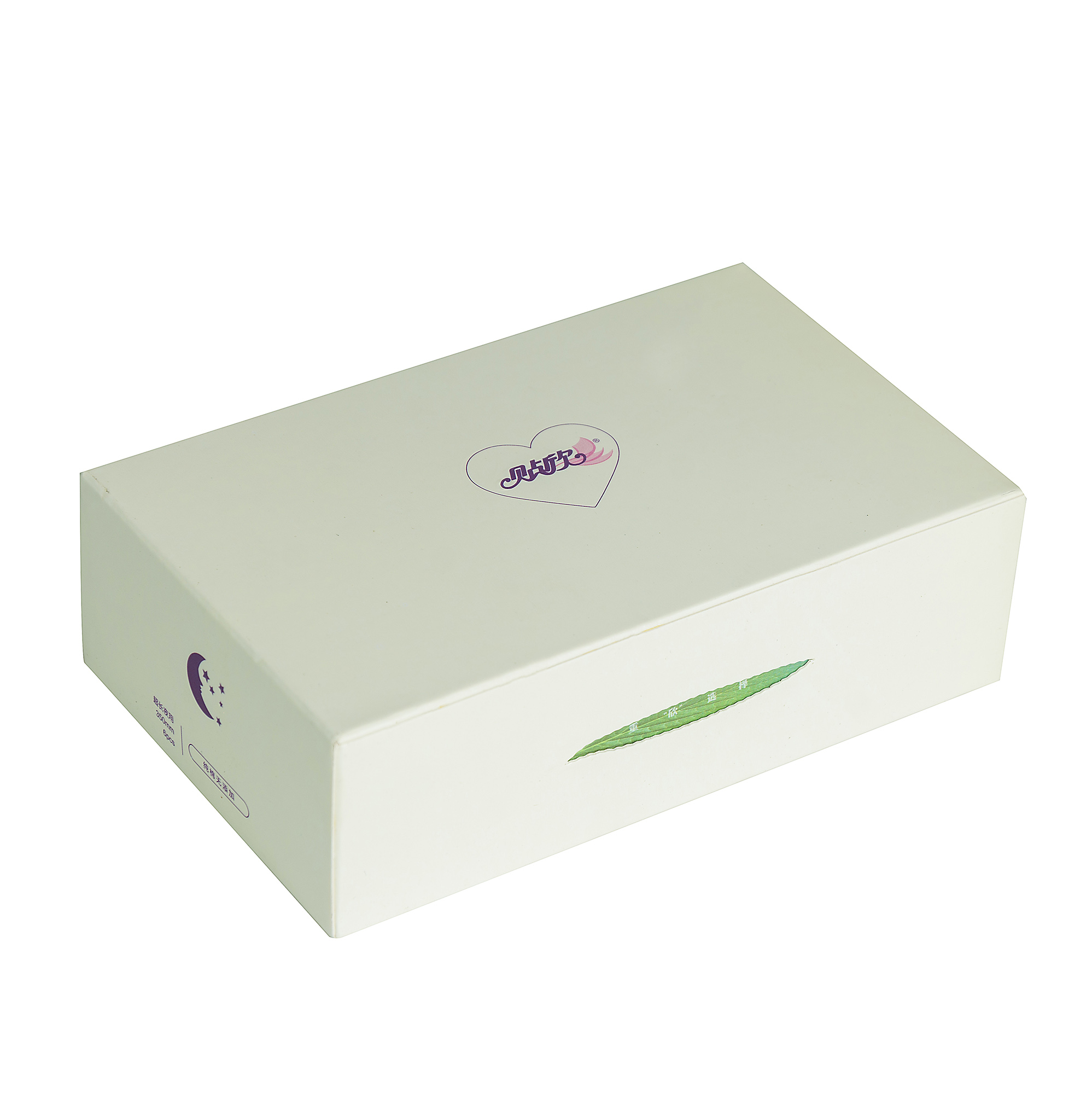
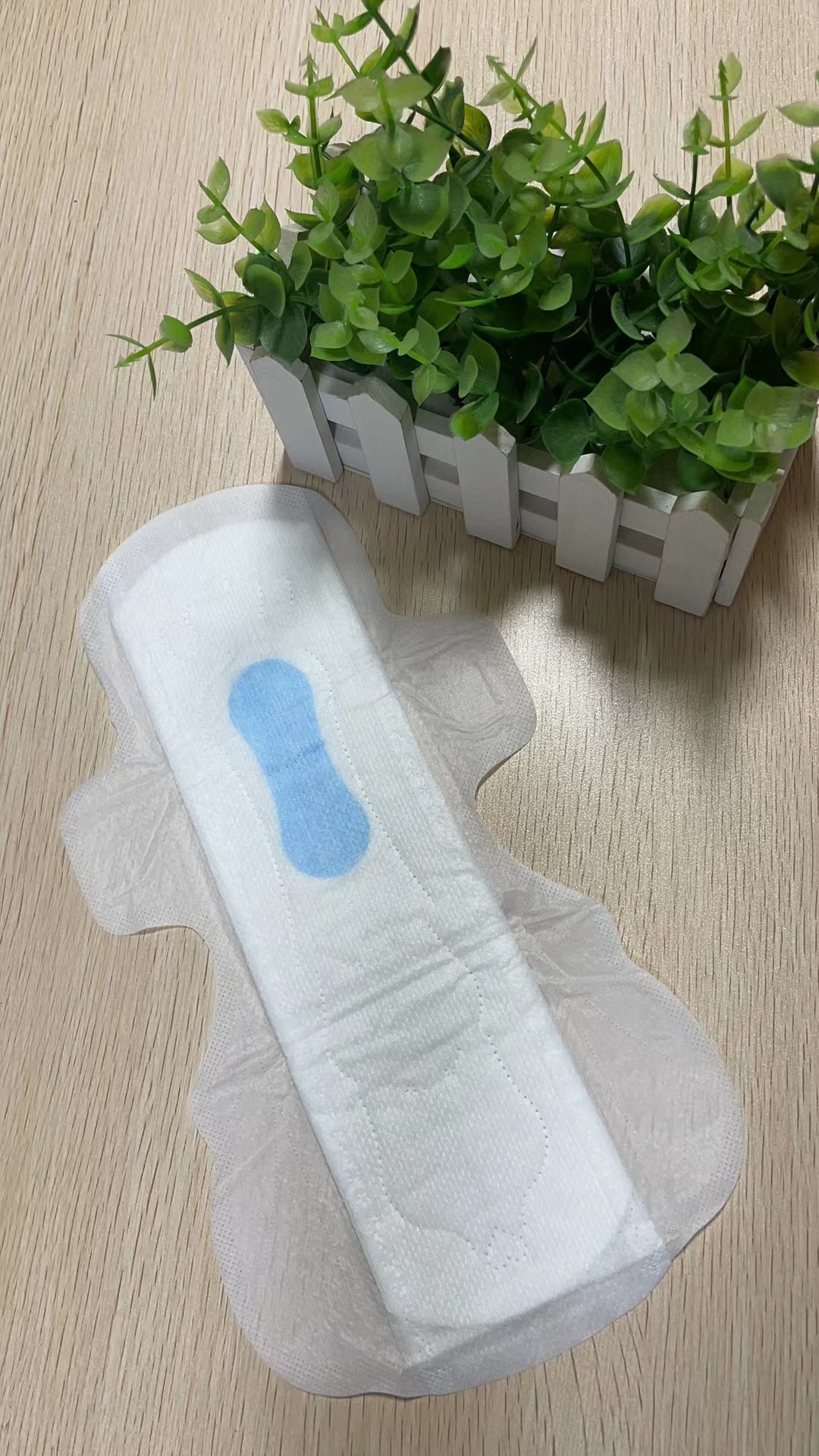
Box-packed disposable sanitary napkins at the packing stage — the last point at which packaging damage can be corrected before a container is sealed.
What “Damaged on Arrival” Actually Means
Damaged on arrival is not one defect. In the feminine hygiene category it describes at least five distinct failure modes, and each one is investigated, documented and claimed differently. Treating them as a single “shipping problem” is the fastest way to lose a claim.
- Moisture ingress and condensation damage. Corrugated board softens, stacks compress, carton print transfers or smears, labels lift, and the outer wrap loses its crispness. In severe cases the product itself shows odour or visible mould. This is the most common arrival complaint because it develops slowly and is invisible while the container doors are closed.
- Contamination. Dust, debris and biological contamination (mould spores) that render the product unsaleable for hygiene reasons even when the pads look intact. For a product worn against the body, contamination is a compliance issue, not a cosmetic one.
- Seal and barrier failure. Wrinkled film, tunnel gaps or partially formed seals. The units may pass a visual check on the pallet while the protective barrier around them has already failed.
- Mechanical damage. Crushed corners, pallet overhang damage and beam pressure from poor loading patterns.
- Identity damage. Mixed SKUs, shifted labels or unreadable batch codes, usually caused by the same handling problems that produce mechanical damage.
The commercial consequences do not scale with how dramatic the damage looks. A container that is rejected at a retail distribution centre still costs the ocean freight in both directions, port and inspection charges, disposal of unsaleable stock, and the listing slot the buyer has already committed to. That is why the useful question is not “who is liable” after arrival, but “which controls were specified” before loading.
Why Sea Freight Humidity Turns Into a Product Problem
A sealed ocean container is a closed micro-climate. As a vessel moves between climate zones, the container shell and the cargo inside warm and cool at different rates, and moisture that is already present in the air and in the packaging materials condenses on the coldest surfaces — typically the container ceiling and the top layers of the load. This condensation behaviour is well understood in container shipping, and it is the reason long-haul ocean freight, rather than the factory, is where most moisture damage is actually created.
Feminine hygiene products are unusually exposed to this effect for two structural reasons. First, the absorbent materials used in the pad itself — cellulose pulp, plant-fibre and cotton-based layers — exchange moisture with the surrounding air rather than repelling it. Second, the outer retail carton is corrugated paper board, which loses stacking strength as it takes on moisture. A carton that tests well in a dry warehouse can behave very differently after four weeks at sea.
The scale of the trade makes this a procurement issue rather than a niche one. The global sanitary pads market was valued at approximately USD 20.4 billion to USD 25.73 billion in 2024, with growth projected at a CAGR of 4% to 5.6% through 2034 (Kings Research and Expert Market Research, via Vertex AI Search). China, the world’s leading exporter of sanitary pads under HS 961900, shipped roughly USD 3.3 billion to USD 3.59 billion in 2024 (OEC / WITS / General Administration of Customs China) — the overwhelming majority of which moved by ocean freight.
The material mix is shifting in a direction that makes packaging protection more important, not less. The biodegradable sanitary napkin segment was valued at USD 2.43 billion in 2023 and is projected to reach USD 8.54 billion by 2030, a CAGR of 20.1% (Mark & Spark Solutions), while organic cotton sanitary napkins reached approximately USD 3.95 billion in 2025 on consumer preference for hypoallergenic, chemical-free products (Providence Strategic Partners). Bio-based, FSC-certified wood pulp and chlorine-free organic cotton formats increase the share of fibre-based material travelling in each container — which is exactly the material most sensitive to ambient humidity.
The Root Causes Worth Separating Before You File a Claim
Arrival damage almost always traces back to one of six causes, and only one of them is outside the manufacturer’s control. Separating them determines whether you are looking at a supplier capability problem or a route-conditions problem.
- An under-specified packaging structure. When packaging is treated as a cost line rather than a performance requirement, buyers receive the thinnest board and the simplest wrap that will pass a quotation review.
- Weak sealing at the wrapping station. Seal quality under humidity and pressure change depends on the film and the sealing parameters, not on the operator’s visual impression.
- Loading practice. Void space, missing edge protection and pallet patterns that concentrate load on the bottom cartons all accelerate compression damage once board moisture rises.
- Container condition and readiness. Aged door seals, unnoticed shell damage and loading during wet weather introduce moisture that the cargo then lives with for the whole voyage.
- No inspection gate before the doors close. If nothing is checked at loading, the first inspection happens at destination — when the evidence is thousands of kilometres away.
- Documentation gaps. Without batch-level material records and an agreed acceptance criterion, there is no neutral basis on which to accept, reject or rework a shipment.
How Family Cares Group Controls Moisture and Contamination Risk
Family Cares Group (Xiamen) is an integrated manufacturing and supply chain group specialising in high-performance hygiene and medical materials, and the manufacturer of Ecolivia disposable sanitary napkins. Founded in 2001, the group operates from more than 35,000 square metres of manufacturing space with 350–500 employees, a 25-strong engineering team and annual output of 650 million+ pieces, with 85%–90% of production exported to North America, Europe, Southeast Asia, the CIS, the Middle East and Africa. Its risk controls are built in five layers, and each layer maps to one of the causes above.
Layer 1 — Packaging engineered as part of the product, not an accessory
For Ecolivia disposable sanitary napkins, packaging is a configurable variable inside the OEM/ODM agreement rather than a fixed afterthought. Buyers can specify brand/logo, sizing, bio-based core structure and packaging configuration together, which means the outer packaging structure — the part that determines whether a carton survives a humid voyage — is defined and costed before production begins.
Layer 2 — Sealed high-barrier film
The immediate protection around the product is a sealed high-barrier film layer that limits moisture exchange between the pads and the container atmosphere. Sealing integrity is treated as a production variable at the wrapping station, not as a cosmetic finish. At material level, the group’s R&D and supply service also customises bio-film layers, nonwoven GSM, spandex and magic tape, so the film and carrier materials in the pad can be tuned alongside the outer barrier.
Layer 3 — 100% on-line visual inspection plus in-house laboratory QC
Every unit passes 100% on-line visual inspection backed by in-house laboratory quality control before cartoning. This is what stops a foam, film or absorbent-core deviation from being packed, sealed and shipped. Traceability is maintained so that a specific batch can be identified after the fact, and the group provides 24/7 technical support and quality traceability as part of the after-sales commitment.

On-line visual inspection: every disposable sanitary napkin is checked before it reaches the sealing and cartoning stage.
Layer 4 — Pre-shipment loading inspection (PSI)
The final gate is a pre-shipment loading inspection (PSI), carried out as the container is being loaded rather than after it arrives. PSI is the control that converts an argument about liability into a documented record of condition at origin. Depending on the agreed terms, acceptance can be structured around pre-shipment inspection or around lab report approval — and buyers can hold the documentation that matches their own incoming-quality process.
Layer 5 — Certification and documentary backbone
Documentation is what turns a control into a verifiable one. The group holds ISO 9001:2015 certification (certificate number 41624QZ644CR0, issued by CQC / IQNet, valid 8 April 2024 to 7 April 2027) covering the design, manufacture and sales of hygiene and medical materials. Its U.S. FDA establishment registration (registration number 3005078659, under 21 CFR Part 807) explicitly covers sanitary napkins and panty liners and is valid through 31 December 2026. CE marking under the EU Medical Device Regulation is held for the group’s regulated care range, with testing referenced to EN ISO 10993. At material level, incoming raw materials are supported by batch COA reports.
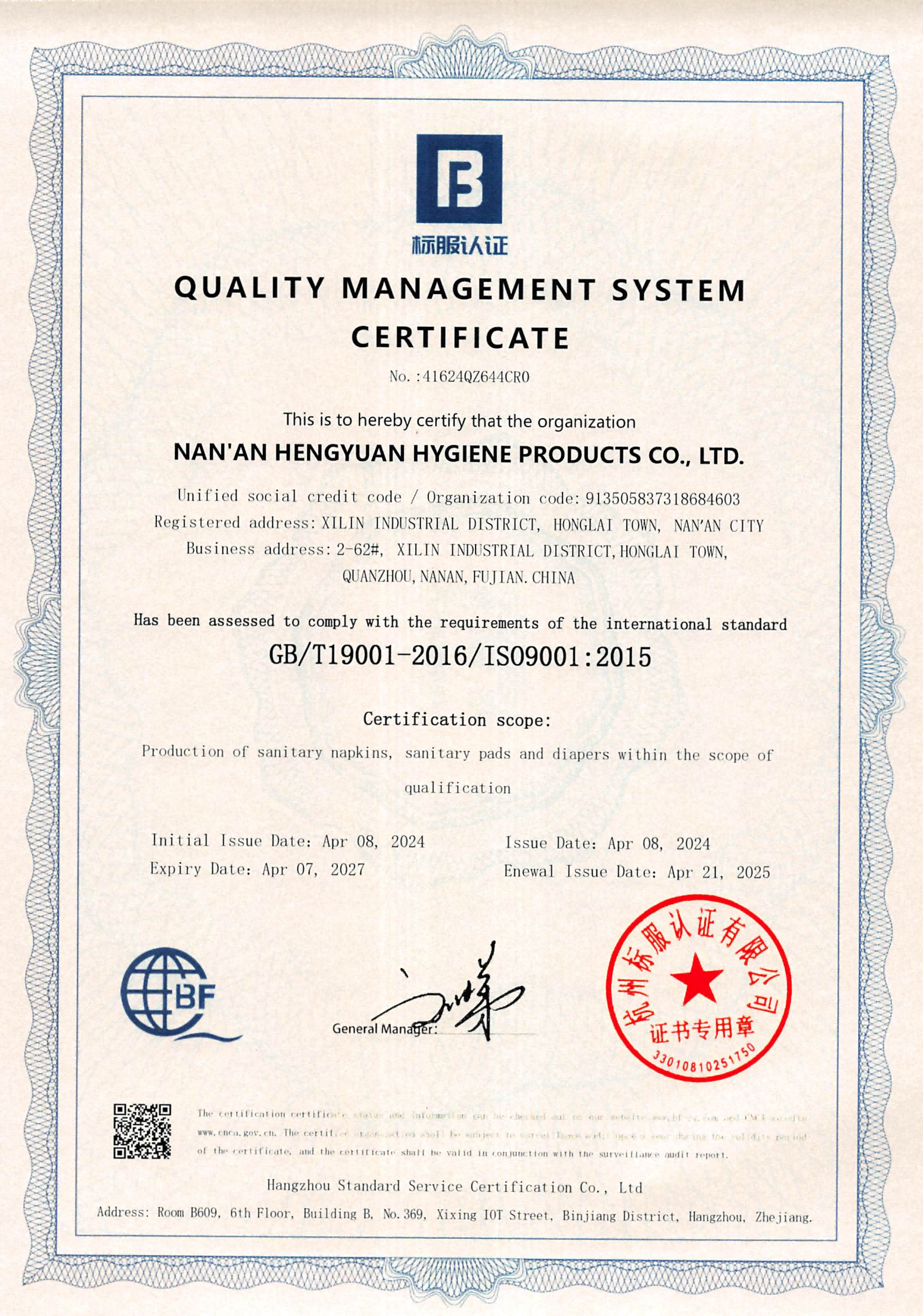
ISO 9001:2015 certification (certificate number 41624QZ644CR0), covering design, manufacturing and sales of hygiene and medical materials.
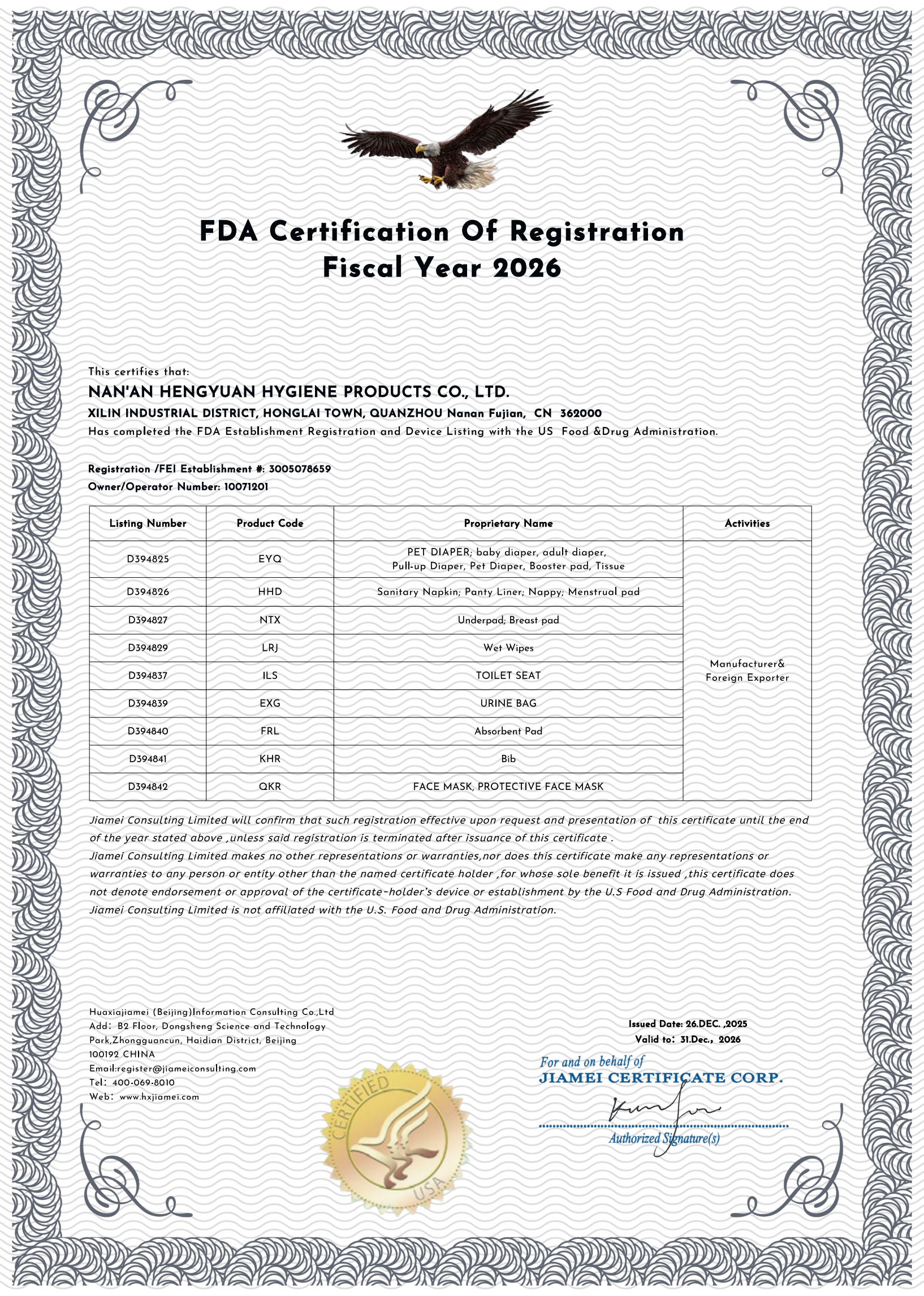
U.S. FDA establishment registration (number 3005078659) under 21 CFR Part 807, covering sanitary napkins and panty liners.
Capacity and lead time behind the controls
Controls only work if the capacity exists to execute them consistently. Family Cares Group runs three production services, each with its own capacity, lead time and quality gate, which allows a buyer to source finished goods, raw materials or logistics support through the same compliance framework.
| Production service | Monthly capacity | Typical lead time | Quality control | Customisation focus |
|---|---|---|---|---|
| OEM/ODM manufacturing (Ecolivia disposable sanitary napkins) | 54 million+ pieces | 15 – 25 days | 100% on-line visual inspection + in-house lab QC | Brand/logo, sizing, bio-based core structure, packaging |
| Material R&D & supply | 1,600+ tons | 7 – 14 days | Batch COA reports | Nonwoven GSM, bio-film layers, spandex, magic tape |
| Supply chain & logistics | 30+ containers (40HQ) | 3 – 5 days (treatment date) | Pre-shipment loading inspection (PSI) | Shipping mode, consolidation, customs clearance support |
Step-by-Step: Protecting a Shipment from Quotation to Container Loading
The following sequence is the practical version of the controls above, written from the buyer’s side of the table. It is designed to be inserted into a purchase agreement before pricing is finalised.
- Lock the packaging specification in writing. Define the multi-layer packaging structure and the sealed high-barrier film as deliverables, not as supplier discretion. Because packaging, sizing, brand/logo and bio-based core structure are all configurable in an OEM/ODM order, the specification can be written into the same document as the product itself.
- Fix the acceptance criterion before you fix the price. Choose pre-shipment inspection or lab report approval as the contractual acceptance basis, and state it explicitly alongside the payment terms (T/T or L/C are the standard options).
- Require batch-level material documentation. Ask for batch COA reports covering the nonwoven, film layers and absorbent materials used in your production run.
- Confirm the in-process inspection gate. Verify that 100% on-line visual inspection and in-house laboratory QC apply to your order, and ask how a failed unit is removed from the line.
- Verify sealing before cartoning. Film seal quality is the control that fails invisibly. It should be confirmed as part of the line inspection routine, before units are boxed.
- Book PSI at loading. Schedule the pre-shipment loading inspection so the record is created while the container doors are still open at origin — this is the single most useful piece of evidence if a claim is ever required.
- Confirm logistics documentation and tracking. Delivery under FOB, CIF or DDP, with consolidation, customs clearance support and real-time tracking, keeps the container documented until the moment it reaches your port.
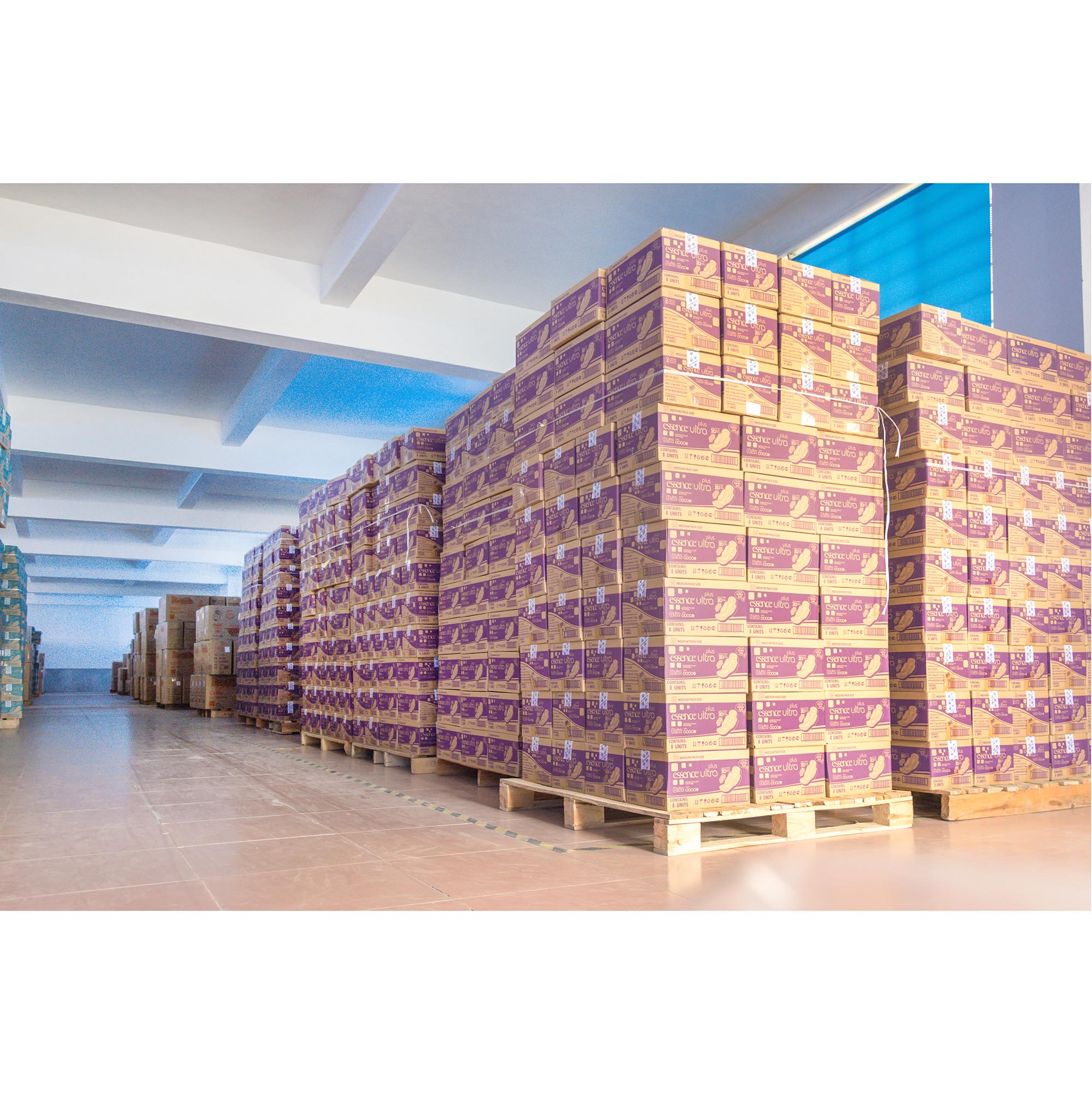
Workshop stage: sealing integrity and carton condition are confirmed before units are palletised and loaded.
Use Cases: Where Moisture Control Changes the Outcome
Premium e-commerce and subscription brand, Germany
A German premium e-commerce and subscription client runs 500,000+ units per batch on a monthly recurring basis, a relationship now in its third year, with products tailored into luxury retail gift boxes. The project supported the client’s transition to 100% plastic-free packaging, and is served by high-capacity automated box-packing lines with zero-defect quality control for premium retail standards. For this buyer, arrival condition is a retail-facing issue: a marked or softened gift box is a customer-visible failure, so packaging structure and box-packing consistency carry the same weight as pad performance.
Top-tier medical and adult care brand, United States
A U.S. medical and adult care brand has taken 2–3 x 40HQ containers per month for more than ten years in a strategic partnership that has maintained a 0% major quality complaint rate while scaling market share. The programme relies on high-absorbency (6,500ml+) core stability and customised medical-grade packaging. The ten-year record illustrates the point that matters most in moisture-risk planning: control systems that hold up over many shipments, not one perfect container.
Leading regional FMCG brand, Malaysia
A regional FMCG brand in Malaysia ships 2–3 x 40HQ containers per month on a 3+ year relationship, delivering 25% annual sales growth in Southeast Asia. The programme integrated advanced bio-based core technology to replace standard SAP, and key highlights included successfully integrating that core change without disrupting supply. For an importer in a high-humidity market, bio-based cores make the barrier and sealing layers more, not less, important.
Sanitary product manufacturer, Uzbekistan
A manufacturer supplied with 500+ tons of nonwoven raw materials annually over four years achieved a 15% reduction in production downtime. The result came from customised GSM and roll diameter matched to high-speed Italian machinery. Material consistency reduces the number of line stoppages and manual interventions — and fewer manual interventions mean fewer handling points where product and packaging can be compromised.
Comparison Table: Risk, Root Cause and the Control That Addresses It
The table below maps each arrival-damage risk to where it originates and to the specific control and document a buyer can request. It is intended to be copied into a supplier evaluation or purchase specification.
| Risk | Where it starts | Control applied | Documentation / evidence |
|---|---|---|---|
| Carton softening and stack compression from humidity | Under-specified outer packaging combined with in-transit humidity | Multi-layer packaging with sealed high-barrier film; packaging defined as a configurable variable in the OEM/ODM order | Agreed packaging specification; brand/logo, sizing and packaging configuration confirmed in the order |
| Product contamination | Handling and packing environment before cartoning | 100% on-line visual inspection plus in-house laboratory QC | Inspection records, quality traceability and 24/7 technical support |
| Seal and barrier failure | Wrapping station parameters and film selection | Sealed high-barrier film; bio-film layers customisable through the material service | Pre-shipment loading inspection record |
| Raw material variability affecting absorbency and structure | Incoming fibre, nonwoven and film quality | Customised nonwoven GSM and roll diameter; batch-level material verification | Batch COA reports; sample testing support |
| Wrong or mixed batch loaded | Loading and pallet assembly stage | Pre-shipment loading inspection (PSI) with pre-agreed acceptance criteria | PSI documentation; acceptance by pre-shipment inspection or lab report approval |
| Compliance rejection at destination | Missing or unverifiable certification | Certified operations: ISO 9001:2015, FDA establishment registration, CE marking for the regulated care range | ISO 9001:2015 certificate 41624QZ644CR0; FDA registration 3005078659; EN ISO 10993-referenced testing |
FAQ
Which certificates and documents should accompany a moisture-sensitive disposable sanitary napkin shipment?
A compliant shipment should be traceable to ISO 9001:2015 certification and to regulatory registration for the destination market. Family Cares Group holds ISO 9001:2015 certification number 41624QZ644CR0, issued by CQC / IQNet and valid from 8 April 2024 to 7 April 2027, covering design, manufacture and sales of hygiene and medical materials. Its U.S. FDA establishment registration number 3005078659, filed under 21 CFR Part 807, covers sanitary napkins and panty liners and is valid through 31 December 2026. CE marking under the EU Medical Device Regulation is held for the regulated care range, with testing referenced to EN ISO 10993. At material level, batch COA reports support incoming raw materials.
How does Family Cares Group physically reduce moisture and contamination risk inside the container?
The controls operate in layers: multi-layer packaging, a sealed high-barrier film around the product, 100% on-line visual inspection with in-house laboratory QC before cartoning, and a pre-shipment loading inspection (PSI) at the point of loading. Packaging, sizing, brand/logo and bio-based core structure are all configurable inside the OEM/ODM agreement, so the protection layer is specified rather than assumed. Finished-goods production runs at 54 million+ pieces per month with a 15–25 day lead time, supported by high-capacity automated packing lines.
What are the purchasing terms if a shipment fails your incoming check?
Two documented term sets are used depending on order type. Standard terms are MOQ of 1 x 20GP, delivery under FOB, CIF or DDP, acceptance by pre-shipment inspection, and payment by T/T or L/C. For trial orders, MOQ is negotiable, delivery is by sea or rail freight, acceptance is by lab report approval, and payment is 30% deposit with 70% balance. Both sets place the acceptance criterion in writing before production, which is what makes a dispute resolvable rather than negotiable after the container has arrived.
Can we validate packaging and product quality before committing to a full container?
Yes. Sample testing support is provided as part of the material R&D and supply service, with a material MOQ of 2 tons or 1 x 40GP depending on the material and a 7–14 day lead time. On the finished-goods side, the OEM/ODM MOQ is 1 x 20GP and is negotiable for start-up brands, so a buyer can run a physical validation of absorbency, film sealing and carton performance before scaling to recurring container volumes.
What lead times apply between order confirmation and container loading?
Lead times differ by service. OEM/ODM manufacturing of Ecolivia disposable sanitary napkins runs 15–25 days at a monthly capacity of 54 million+ pieces. Material R&D and supply runs 7–14 days at 1,600+ tons per month. Supply chain and logistics handling, including documentation and loading preparation, runs 3–5 days (treatment date) across 30+ x 40HQ containers per month. To check packaging performance and lead time against your own acceptance criteria, request a sample set or a quotation from Family Cares Group at admin@family-cares.com or +86 13805968557 (also available on WhatsApp), or review the manufacturer profile at family-cares.com.
Conclusion: Damage Is Cheaper to Prevent Than to Claim
Arrival damage in the disposable sanitary napkin category is a specification failure before it is a shipping failure. The four variables that decide the outcome are the packaging structure, the sealing barrier, the in-process inspection gate and the pre-shipment inspection record — and all four are negotiated before production begins, not after the container doors are opened at destination.
Family Cares Group applies these controls across a certified operation: ISO 9001:2015 certification, FDA establishment registration covering sanitary napkins, CE marking for the regulated care range, 54 million+ pieces of monthly OEM/ODM capacity on 15–25 day lead times, and PSI on every loading. For importers and private-label brands in the evaluation and execution stages, the practical next step is to write the packaging and acceptance specification into the order, then verify it with a physical sample before committing to recurring container volume.
Validate Packaging Before You Book the Container
Request a sample set to test sealing, carton performance and absorbency against your own acceptance criteria, or ask for a quotation with PSI and lab report approval written in.
Family Cares Group (Xiamen) — www.family-cares.com
Email: admin@family-cares.com | Tel / WhatsApp: +86 13805968557
Xilin Industrial District, Honglai Town, Quanzhou Nan’an City, Fujian Province, China
Have Questions or Need More Details?
Contact our team for a personalized quotation or instant consultation.
Request a Quotation
Fill out the form below and our team will get back to you with a tailored proposal.
WhatsApp Direct Chat
Prefer to chat in real-time? Message us on WhatsApp for instant assistance & quick answers.
- Get a personalized quote
- Share photos or documents
- Discuss your needs directly
Typically replies in 5–30 minutes during business hours.