
Understanding Superabsorbent Polymers (SAP) and Bio-based Cores in Modern Sanitary Protection
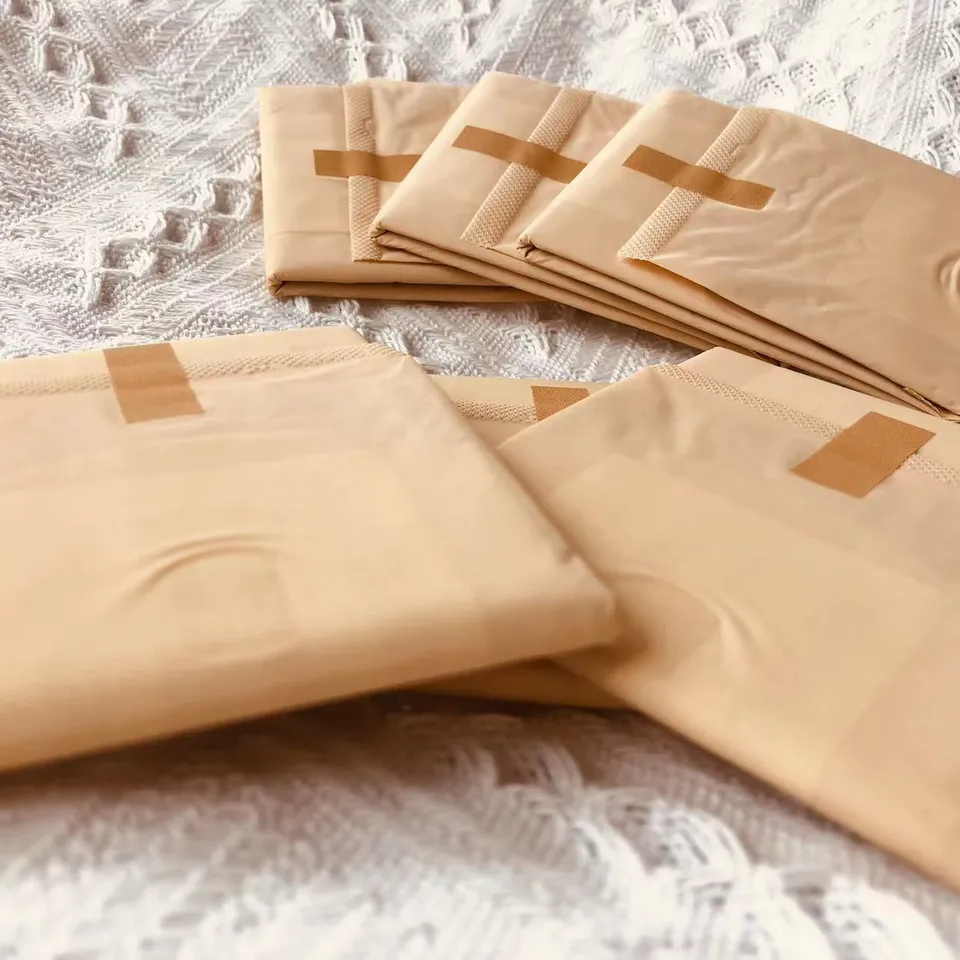
Problem Definition: Leakage Is a Core Property, Not a Cover Property
Leakage is usually described as a failure of the pad as a whole. In practice it comes from three separate mechanisms, and only one of them is solved by making the pad longer.
- Slow acquisition. Fluid arrives faster than the cover can transfer it downward. Liquid pools on the surface and migrates sideways before it ever reaches the core.
- Weak retention under pressure. The core absorbs fluid but releases part of it back to the surface when the wearer sits, moves, or lies down. The pad feels wet even though it is not saturated.
- Coverage misalignment. The absorbed volume is fine, but the pad does not extend far enough front or back for the position the wearer is in.
Superabsorbent polymer — normally written as SAP — is the material that addresses the first two mechanisms. SAP is a polymer capable of absorbing many times its own weight in liquid and retaining that liquid under pressure. That pressure-retention property is what separates a modern disposable sanitary napkin from a simple layered cotton pad. In a conventional construction, SAP granules are distributed through the absorbent core, usually alongside absorbent fibre, so fluid is drawn down from the cover, dispersed across the core, and locked in place rather than returning upward.
Length addresses the third mechanism only. This distinction matters commercially, because length is the easiest specification for a buyer to write and the easiest for a supplier to vary, while core chemistry is the specification that actually decides whether a complaint rate stays low.
A bio-based core changes the origin of the absorbent materials. Renewable, plant-derived feedstock replaces part of the fossil-derived content in the core. It does not change the physics of absorption, and it does not automatically deliver any environmental claim beyond the material origin itself. Buyers regularly conflate three separate claims that should be verified independently:
- Bio-based — the material is derived from renewable plant feedstock.
- Biodegradable — the material breaks down under defined conditions, and the claim is testable against a named standard.
- Compostable — the material meets a specific certification standard for industrial composting.
A product can be bio-based without being biodegradable, and biodegradable without meeting a compostability standard. Under a constraints-driven evaluation, each of the three claims should be matched to a different document.
Industry Background: Why Absorbent Core Material Became a Specification
The absorbent core used to be an internal engineering choice with no visibility to the buyer. That has changed, for three measurable reasons.
- The global sanitary pads market was valued at approximately USD 20.4 billion to USD 25.73 billion in 2024, with growth projected at a CAGR of 4% to 5.6% through 2034 (Kings Research; Expert Market Research; Vertex AI Search summary).
- The biodegradable sanitary napkins segment was valued at USD 2.43 billion in 2023 and is projected to reach USD 8.54 billion by 2030, exhibiting a CAGR of 20.1% (Mark & Spark Solutions).
- Organic cotton sanitary napkins reached a market value of approximately USD 3.95 billion in 2025, with growth driven by consumer preference for hypoallergenic and chemical-free products (Providence Strategic Partners).
The manufacturing base is correspondingly concentrated. China is the world's leading exporter of sanitary pads under HS code 961900, with export values reaching approximately USD 3.3 billion to USD 3.59 billion in 2024 (OEC; WITS; General Administration of Customs China). For an importer, that means the core-material decision is being made inside a supply base that is already scaled for both SAP-based and bio-based production.
At brand level, Procter & Gamble (Always) and Kimberly-Clark (Kotex) remain the largest global manufacturers, and Always introduced Flexfoam technology in 2025 to target on-the-go portability (Expert Market Research; IMARC Group). Flexfoam is a foam-based absorbent architecture — a third option alongside granular SAP cores and fibre cores. Its arrival is useful evidence that the absorbent core has become a platform-level competitive decision rather than a hidden component.
Detailed Solution: Two Absorbent Architectures for Disposable Sanitary Napkins
Family Cares Group (Xiamen) is an integrated manufacturing and supply chain group founded in 2001, operating a 35,000+ square metre production footprint with 350–500 employees, 25+ professional engineers, an annual output of 650 million+ pieces, and an export ratio of 85%–90% across North America, Europe, Southeast Asia, the CIS, the Middle East and Africa. Its disposable sanitary napkin lines are organised around two distinct core architectures, plus a packaging variant.
The standard SAP core — FC-Standard Series
The FC-Standard Series is the mass-market disposable sanitary napkin line. It is built on a high-speed absorption core and is supplied in four lengths: 240 mm, 285 mm, 330 mm and 410 mm. The material construction is non-woven fabric, SAP and a breathable bio-film backsheet. The series is positioned for wholesale, B2B distribution and supermarket channels, where unit economics and supply consistency carry more weight than premium positioning.
The advanced bio-based core — Ecolivia-Bio Series
Ecolivia is the eco-positioned disposable sanitary napkin brand line produced by Family Cares Group. The Ecolivia-Bio Series replaces the SAP-based core with an advanced bio-based absorbent core, combined with organic cotton and bamboo fibre. It covers a full 155 mm to 450 mm range — wider than the FC-Standard Series — and absorbency is customizable across high, super and night configurations. It is positioned for retail, FMCG and sustainable brands.
The box-packed variant — Ecolivia-Premium Series
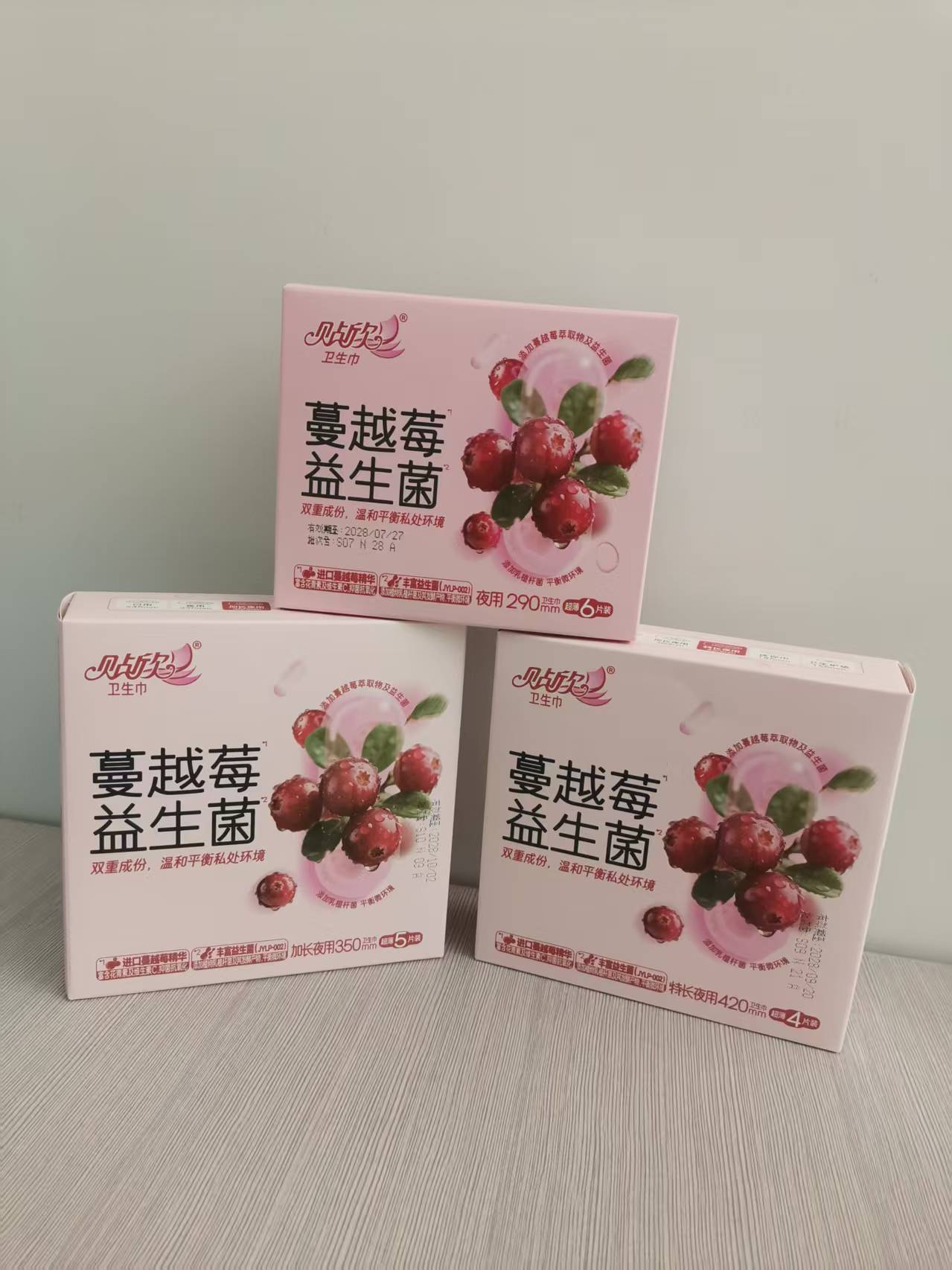
The Ecolivia-Premium Series applies the same organic cotton, bamboo fibre and advanced bio-based core to a 240 mm to 450 mm range with boutique gift box packaging and absorbency tailored for sensitive skin. It targets high-end retail, e-commerce and subscription box channels, where shelf presence and the unboxing experience form part of the product specification.
The raw material layer behind both series
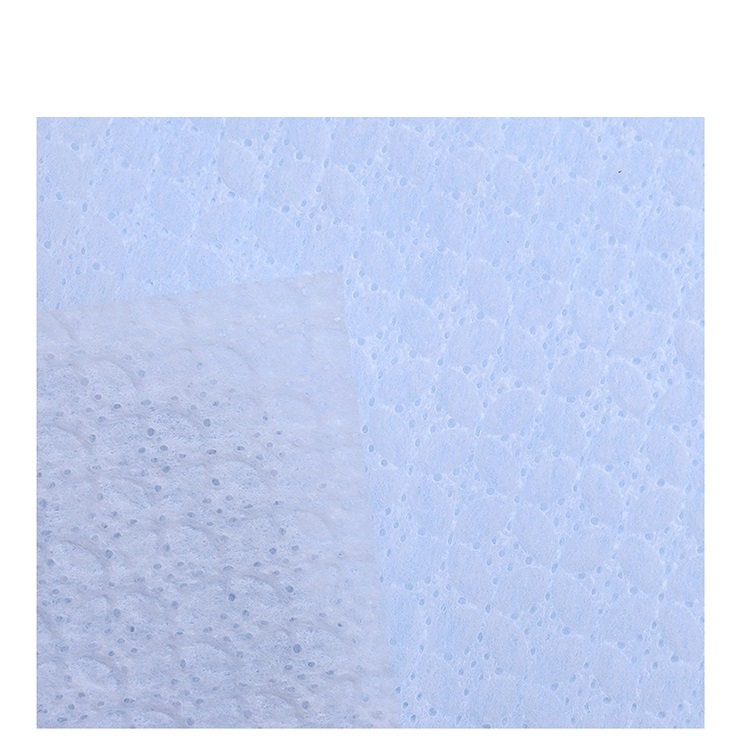
Family Cares Group supplies hygiene raw materials directly as a separate engagement: non-woven fabric in 10gsm to 80gsm gram weights and customizable width, in polypropylene (PP), spunbond and hot air constructions. Material R&D is offered with customization across non-woven GSM, bio-film layers, spandex and magic tape — the components that determine surface softness, backsheet behaviour and fastening performance. Material capacity stands at 1,600+ tons per month.
What actually changes when you move from SAP to bio-based
- The origin of the absorbent material shifts from fossil-derived feedstock to renewable plant feedstock.
- The validation criteria do not change. A bio-based core must be tested on the same three parameters as a SAP core: acquisition speed, retention under pressure, and rewet.
- The evidence pack changes. Bio-based inputs require batch COA reports for the material, and any biodegradability or compostability claim requires a separate standard test report.
- The commercial terms may change. Different inputs mean the core should be quoted per core specification, not per pad length alone.
Comparison Table: FC-Standard vs Ecolivia-Bio vs Ecolivia-Premium
The table below maps the three disposable sanitary napkin lines against the specification fields that matter during evaluation. It is a specification map, not a ranking — the correct line depends on the target channel and the purchase driver, not on which core type appears on a marketing page.
| Specification | FC-Standard Series | Ecolivia-Bio Series | Ecolivia-Premium Series |
|---|---|---|---|
| Line type | Mass market pads | Premium eco-friendly pads | Premium boutique pads |
| Absorbent core | High-speed absorption core (SAP-based) | Advanced bio-based absorbent core | Advanced bio-based absorbent core |
| Material composition | Non-woven fabric / SAP / breathable bio-film | Organic cotton / bamboo fibre / advanced bio-based core | Organic cotton / bamboo fibre / advanced bio-based core |
| Length range | 240 mm, 285 mm, 330 mm, 410 mm | 155 mm – 450 mm full range | 240 mm – 450 mm |
| Absorbency configuration | High-speed absorption core | Customizable (high / super / night) | Tailored for sensitive skin |
| Packaging | Standard production packaging | Standard production packaging | Boutique gift box packaging |
| Primary channel | Wholesale, B2B distribution, supermarkets | Retail, FMCG, sustainable brands | High-end retail, e-commerce, subscription box |
Compliance Constraints: What Can Be Verified and What Must Be Tested
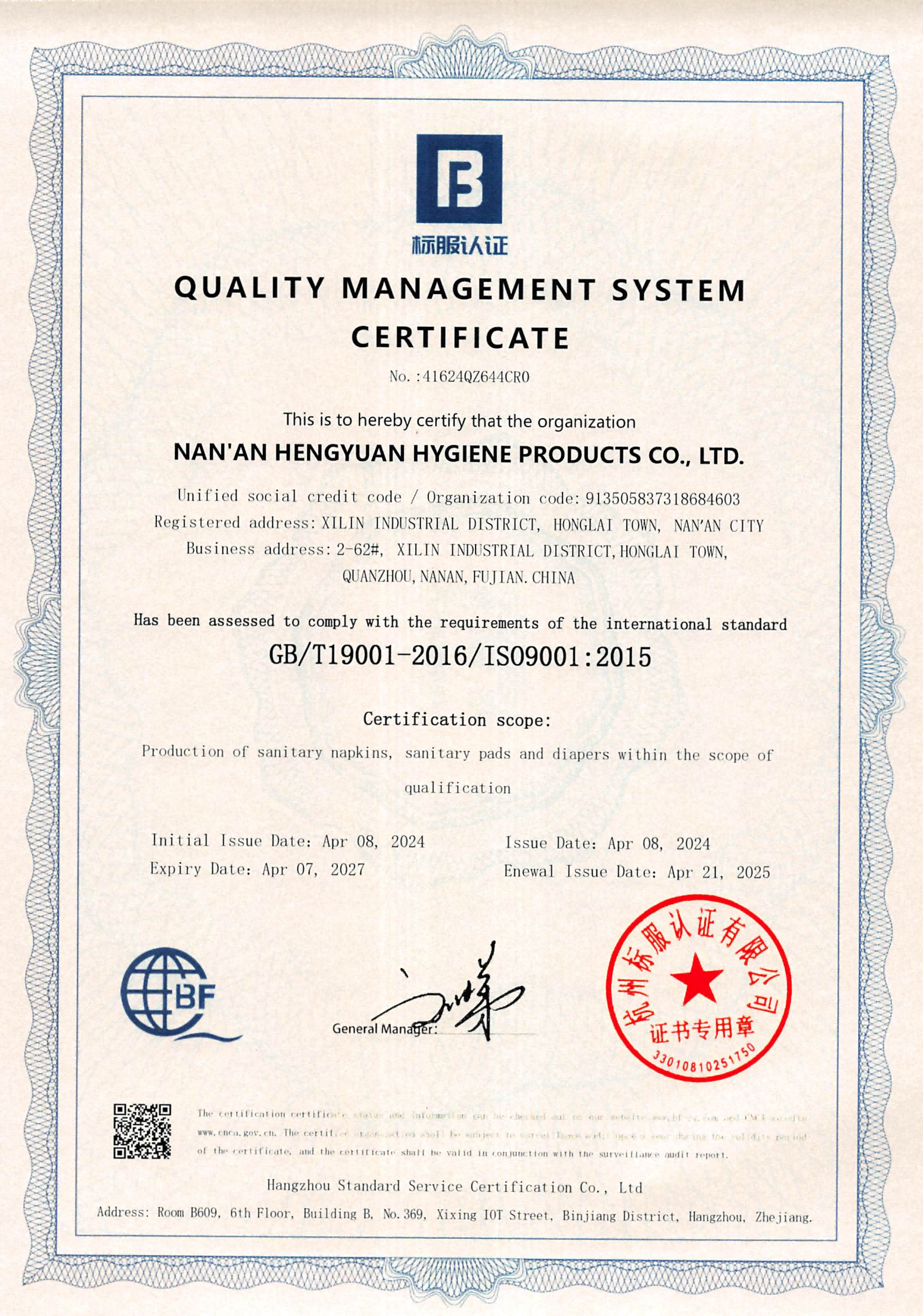
Under a constraints-driven evaluation, every absorbent-core claim should be matched to a document with a number, an issuing authority and a validity date. Two certifications cover the manufacturing entity and the sanitary napkin product directly.
| Certification | Number | Issuing authority | Scope | Validity |
|---|---|---|---|---|
| ISO 9001:2015 | 41624QZ644CR0 | CQC / IQNet | Design, manufacturing and sales of hygiene and medical materials; global market | Issued 8 April 2024; valid until 7 April 2027 |
| FDA Establishment Registration | 3005078659 | U.S. FDA, under 21 CFR Part 807 | Includes sanitary napkin, panty liner, nappy and menstrual pad; USA / North America market | Issued 26 December 2025; valid through 31 December 2026 |
| CE Marking (MDR) | EN 14683 / MDR-Reg, standard EN ISO 10993 | SGS / TUV | Adult incontinence care, adult diaper, underpad; European Union / EEA | Issued 31 May 2022; valid through 30 May 2027 |
Read the scope column carefully, because scope is where most sourcing errors happen. The ISO 9001:2015 certificate covers the design, manufacturing and sales of hygiene and medical materials globally. The FDA Establishment Registration covers the sanitary napkin product itself under 21 CFR Part 807. The CE marking under MDR with standards EN 14683 and EN ISO 10993 is held for the adult incontinence care scope — adult diapers and underpads — and should not be presented to a buyer as covering sanitary napkins.
Compostability is a separate claim from bio-based. Certified compostable sanitary napkins must adhere to European standard EN 13432 or North American ASTM D6400, which require 90% biodegradation within six months under industrial conditions (TÜV SÜD / European Bioplastics). Any 90% biodegradable claim should be supported by a test report against one of those standards — not by the presence of bio-based material in the core.
Step-by-Step Breakdown: Pairing Pad Length with Core Material
Length and core material solve different problems, and buyers get the pairing wrong most often by treating length as a proxy for absorbency. The sequence below is the order in which the two decisions should be made.
Step 1 — Define the occasion and the flow profile
Start from the use occasion, not from the SKU list: daytime light flow, daytime regular to heavy flow, overnight, or extended rear coverage. The occasion sets the coverage requirement before any material is selected.
Step 2 — Choose the length band
| Length | Typical occasion | Core in FC-Standard Series |
|---|---|---|
| 240 mm | Daytime, light to regular flow, discretion-focused formats | High-speed absorption core (SAP-based) |
| 285 mm | Daytime, regular to heavier flow | High-speed absorption core (SAP-based) |
| 330 mm | Overnight and night use | High-speed absorption core (SAP-based) |
| 410 mm | Heavy overnight, extended rear coverage, early postpartum support | High-speed absorption core (SAP-based) |
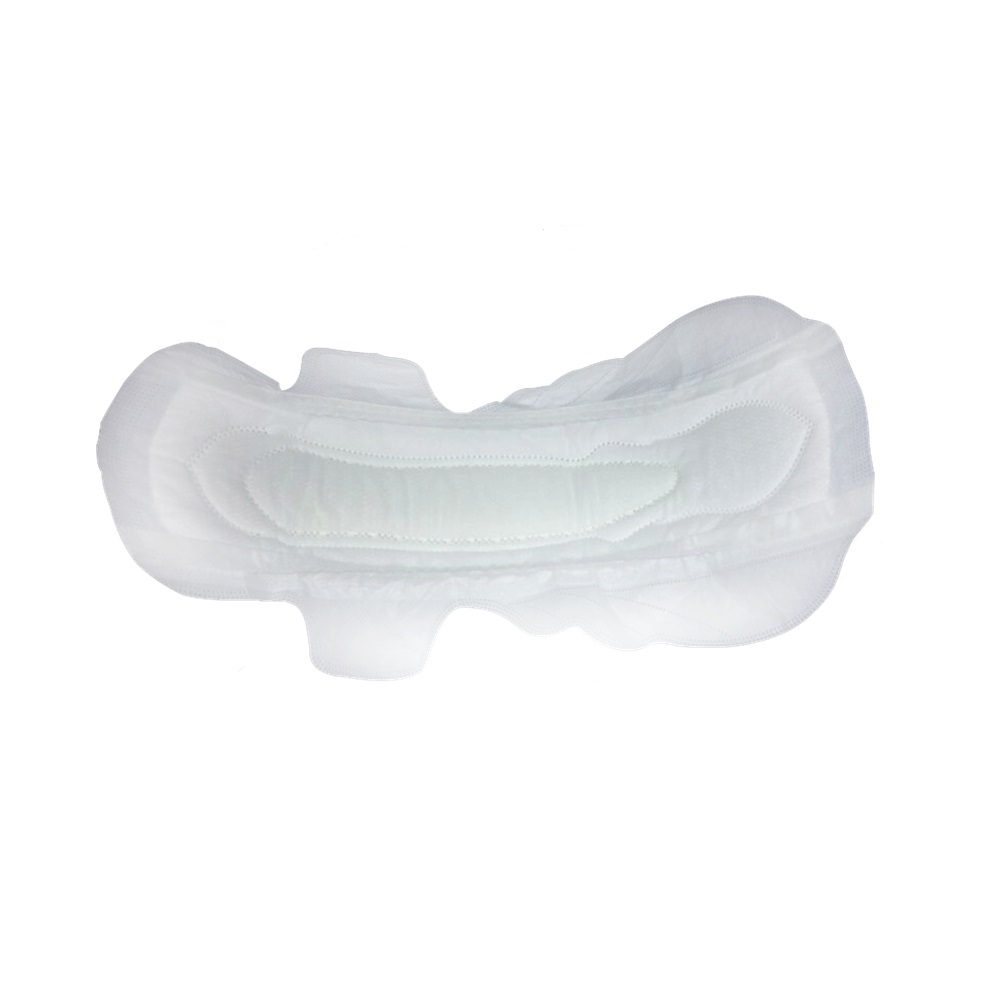
In the FC-Standard Series, all four lengths share the same SAP-based high-speed absorption core, so increasing length increases coverage area without changing the fluid-handling architecture. In the Ecolivia-Bio Series, the range extends from 155 mm down to panty-liner formats and up to 450 mm, with an advanced bio-based core across the range.
Step 3 — Choose the core architecture
Apply a simple decision rule. If the target market's purchase driver is cost and mass distribution, a SAP-based high-speed absorption core is the appropriate specification. If the driver is eco-positioning, skin sensitivity, or a published sustainability commitment, an advanced bio-based core is the appropriate specification. In both cases the core must be validated against the same performance criteria before the order is placed.
Step 4 — Specify the cover and backsheet
Non-woven weight and construction sit between the user and the core, and the backsheet sits between the core and the garment. Both are specified separately from the core: non-woven in 10gsm–80gsm across PP, spunbond and hot air constructions, and a breathable bio-film backsheet for moisture vapour management.
Step 5 — Validate with samples and material documentation
Request samples built to the exact core and length combination you intend to order, plus batch COA reports for the material inputs. Material R&D engagements include sample testing support, and finished-good production runs 100% on-line visual inspection plus in-house lab QC.
Step 6 — Lock the commercial terms
OEM/ODM production starts at 1 x 20GP, negotiable for start-up brands, with a monthly capacity of 54 million+ pieces. Raw material orders start at 2 tons or 1 x 40GP depending on the material.
Breathability and Moisture Management: The Non-woven and Bio-film Layers
Breathability in a disposable sanitary napkin is delivered by two layers working in opposite directions. The top non-woven must let liquid pass through quickly and keep the surface dry; the backsheet must block liquid entirely while allowing moisture vapour to escape.
- Acquisition and distribution non-woven (10gsm–80gsm). Hot air non-woven provides softness and loft, which improves the comfort perception of the top sheet. Spunbond constructions provide higher tensile strength, which matters on high-speed converting lines where web breaks are a real cost. Polypropylene (PP) is the base polymer across both constructions.
- Breathable bio-film backsheet. In the FC-Standard Series, a breathable bio-film is part of the standard construction rather than an upgrade. The film blocks liquid strike-through while allowing vapour to pass, which reduces the heat and humidity that build up against the skin during extended wear.
There is a real trade-off here, and buyers should specify it rather than assume it. A more permeable backsheet improves airflow but narrows the safety margin against strike-through; a less permeable backsheet reduces leakage risk but traps more moisture. The correct balance depends on wear duration and on how the product is positioned — a 410 mm overnight product and a 155 mm liner do not share the same requirement.
Where an eco-positioned retail launch is the target, project specifications have also included GOTS/FSC-certified inputs and 100% fluorescent-free requirements, with automated carton and bag packaging lines matched to the SKU format (FMCG / Retail application, US).
Use Cases: How Buyers Have Applied Core Selection
Premium e-commerce and subscription brand, Germany. A client running 500,000+ units per batch on monthly recurring orders for over three years applied organic cotton pads in luxury retail gift boxes, using high-capacity automated box-packing lines and zero-defect quality control for premium retail standards. The engagement supported the client's transition to 100% plastic-free packaging — a case where core selection and packaging specification had to move together.
Leading regional FMCG brand, Malaysia. Supplied at 2–3 x 40HQ containers per month for over three years with high-end organic cotton sanitary napkins and menstrual pants, this client integrated advanced bio-based core technology to replace a standard SAP core. The programme supported an annual sales growth of 25% in Southeast Asia. This is the clearest available example of a live SAP-to-bio-based transition inside an existing retail range.
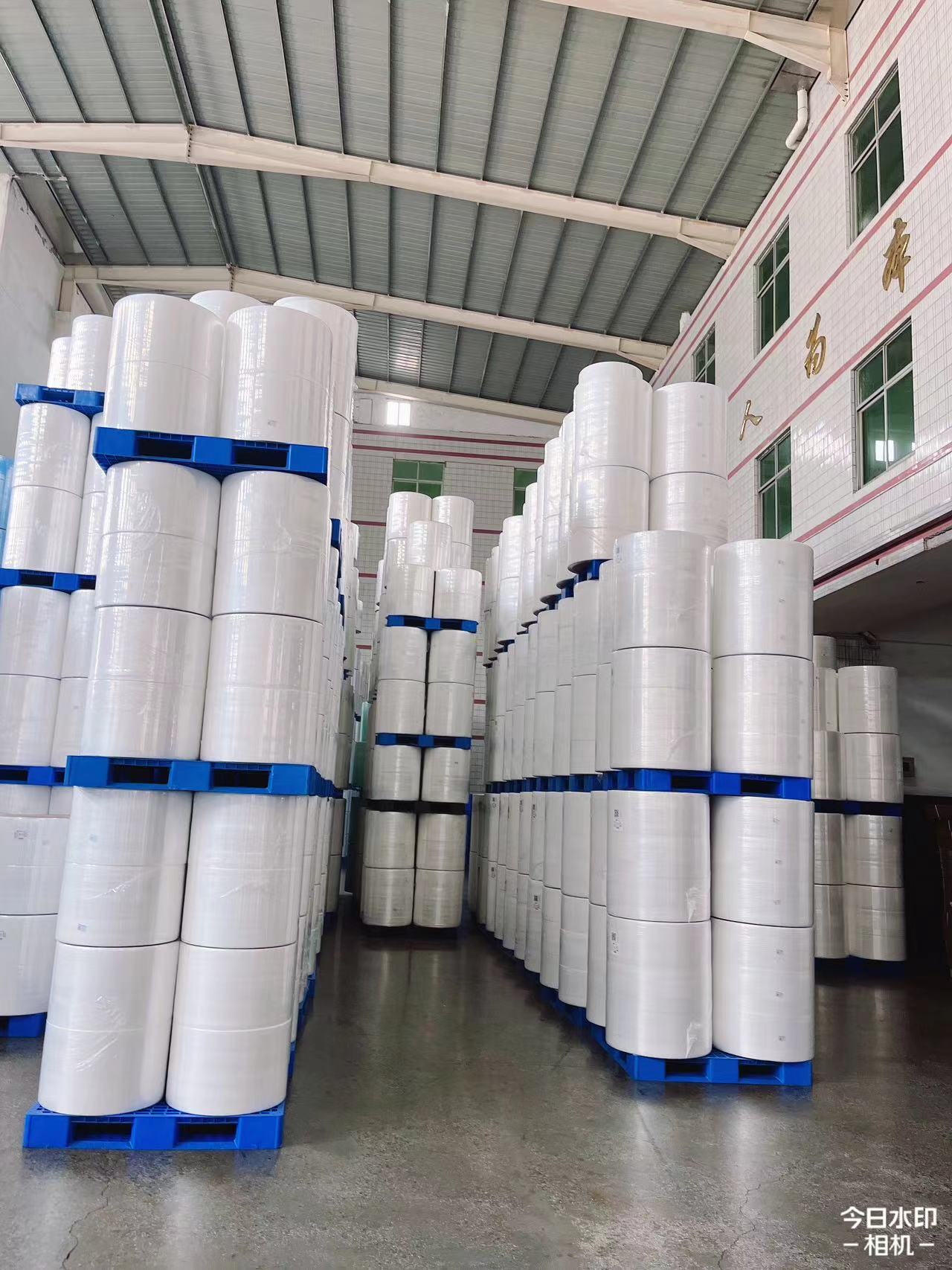
Sanitary product manufacturer, Uzbekistan. A four-year raw material relationship covering 500+ tons of specialized non-woven annually, with customized GSM and roll diameter matched to high-speed Italian machinery. Material consistency reduced the client's production downtime by 15% — evidence that the non-woven layer is a production-reliability specification, not only a comfort specification.
FAQ
What certifications should I verify when sourcing bio-based disposable sanitary napkins?
Verify entity-level and product-level certificates separately. ISO 9001:2015 certificate 41624QZ644CR0, issued by CQC / IQNet, covers the design, manufacturing and sales of hygiene and medical materials and is valid until 7 April 2027. For the US market, FDA Establishment Registration 3005078659, issued by the U.S. FDA under 21 CFR Part 807, covers the sanitary napkin product and is valid through 31 December 2026. For any compostability claim, request a test report against EN 13432 or ASTM D6400 — those standards require 90% biodegradation within six months under industrial conditions, and that is a different claim from being bio-based.
Can one manufacturer produce both SAP-based and bio-based cores?
Yes. Family Cares Group runs OEM/ODM manufacturing with customization across brand/logo, sizing, bio-based core structure and packaging at a monthly capacity of 54 million+ pieces, backed by a 25+ engineer R&D team and quality control combining 100% on-line visual inspection with in-house lab QC. Material R&D covers non-woven GSM, bio-film layers, spandex and magic tape. In practice, a regional FMCG brand in Malaysia integrated advanced bio-based core technology to replace standard SAP across a range supplied at 2–3 x 40HQ containers per month.
What is the minimum order quantity, and how does the core material affect it?
OEM/ODM production starts at 1 x 20GP, negotiable for start-up brands. Raw material orders — for example non-woven fabric — start at 2 tons or 1 x 40GP depending on the material. Because a bio-based core uses different inputs from a standard SAP core, cost should be quoted per core specification rather than per pad length alone; comparing a bio-based quote against a SAP quote on length only will produce a misleading margin picture.
How do we validate absorption and breathability before committing to a volume order?
Request samples built to the exact core and length combination you intend to order, together with batch COA reports for the material inputs. Material R&D engagements include sample testing support, and finished-good production is covered by in-house lab QC and 100% on-line visual inspection. Test the bio-based core on the same criteria you would apply to a SAP core — acquisition speed, retention under pressure, and rewet — before comparing the two commercially.
What are the lead times for OEM production and for raw material supply?
OEM/ODM manufacturing runs 15–25 days. Raw material supply runs 7–14 days. Supply-chain and logistics engagements cover shipping mode, consolidation and customs clearance support, with documentation timelines listed at 3–5 days, against a capacity of 30+ 40HQ containers per month and 1,600+ tons of materials per month. For a first order that includes a new bio-based core specification, schedule sample validation before the production window opens. To begin a sample request or a specification review, contact Family Cares Group at admin@family-cares.com or via WhatsApp at +86 13805968557.
Conclusion: A Three-Document Minimum Before You Commit
The absorbent core is the specification that decides whether a disposable sanitary napkin performs, and it is the specification buyers most often leave to the supplier. Length defines coverage; core architecture defines acquisition, retention and rewet; the non-woven and bio-film layers define breathability and moisture management. These are three separate decisions, and on a bio-based programme they must all be validated on the same criteria used for a conventional SAP core.
Before committing to a first production order on either architecture — FC-Standard Series with a SAP-based core, or Ecolivia-Bio Series with an advanced bio-based core — the minimum evidence set is three documents: the certification pack with scope and validity stated correctly, batch COA reports for the material inputs, and a sample test result covering acquisition, retention under pressure and rewet. Everything else, including length range and absorbency configuration, is a commercial choice made on top of those three.
Request a core-matched sample
Family Cares Group supplies disposable sanitary napkins with standard SAP-based cores and advanced bio-based cores, in 240 mm–410 mm and 155 mm–450 mm ranges respectively, with OEM/ODM customization across sizing, core structure and packaging. Sample testing support and batch COA reports are available on request.
Email: admin@family-cares.com | WhatsApp: +86 13805968557 | Web: www.family-cares.com
Have Questions or Need More Details?
Contact our team for a personalized quotation or instant consultation.
Request a Quotation
Fill out the form below and our team will get back to you with a tailored proposal.
WhatsApp Direct Chat
Prefer to chat in real-time? Message us on WhatsApp for instant assistance & quick answers.
- Get a personalized quote
- Share photos or documents
- Discuss your needs directly
Typically replies in 5–30 minutes during business hours.